What Makes Government Translation Procurement High Risk?
The pressure on procurement officers continues to intensify across government organisations. When local authorities face urgent translation needs for public health communications, procurement decisions can directly impact community safety. Translation and localisation procurement has evolved from a routine administrative task to a strategic risk management function with significant consequences. This scenario reflects the new reality facing procurement teams across UK government organisations. Translation and localisation procurement has evolved from a routine administrative task to a strategic risk management function with far-reaching consequences. Today’s procurement officers are grappling with unprecedented challenges that extend well beyond simple cost considerations.
Emergency communications often require rapid multilingual deployment capabilities — delays or mistranslations in crises can undermine public safety and effective response. Legal obligations under the Equality Act 2010 and the Public Sector Equality Duty have created complex requirements that poorly managed translation projects can fall short of, inviting legal challenge and regulatory scrutiny. Healthcare translation accuracy is now recognised as a patient safety issue, with NHS guidance warning that mistranslations can compromise care and create liability exposure for trusts. The digital transformation of government services has also introduced new complexities, with UK regulations requiring compliance with WCAG 2.1 AA standards to ensure accessibility for diverse populations.
Post-Brexit regulatory changes continue to impact international documentation needs, whilst evolving demographics create demand for previously uncommon languages across local authorities and national agencies. Modern procurement officers find themselves searching for answers to increasingly complex questions about emergency communication protocols, multilingual government contract management, and compliance frameworks that didn’t exist five years ago. These aren’t just operational concerns — they’re strategic imperatives that can determine whether projects succeed or fail, whether public trust is maintained or eroded, and whether organisations face regulatory scrutiny or commendation.
Why Cheap Translation Providers Cost More in Government Contracts
The instinct to optimise for cost remains strong amongst decision-makers facing budget pressures. Many procurement teams still ask what is the most cost-effective approach to translation services, but this question fundamentally misunderstands the risk-reward equation in government translation procurement. Consider the type of scenario that can unfold when organisations prioritise cost over quality in translation procurement. Poor translation decisions can lead to compliance violations under the Equality Act, triggering regulatory penalties. The need to retranslate materials to meet quality standards often costs several times the original contract value. Patient safety concerns arising from translation errors can expose NHS trusts to litigation risks. The reputational damage to an organisation’s standing in the community can affect public confidence and staff morale for years.
This pattern repeats across government organisations that focus primarily on initial cost savings rather than total cost of ownership and risk mitigation. Quality assurance failures trigger expensive appeals and revision processes that consume internal resources far beyond the original project scope. Regulatory investigations often arise from translation-related compliance issues, generating legal costs that dwarf any initial savings. Public backlash from poorly translated communications requires crisis management responses that can cost more than the entire original translation budget. Operational disruption becomes another hidden cost when translation failures delay critical project timelines. Emergency retranslations conducted under pressure conditions can cost significantly more than normal rates whilst often delivering inferior results due to rushed timelines. Staff overtime costs mount as internal teams struggle to manage vendor failures and coordinate damage control efforts.
The compliance risks embedded in poor translation procurement decisions create ongoing liability that extends far beyond individual projects. Data protection violations under GDPR can result from inadequate vendor security protocols. Accessibility non-compliance affects vulnerable populations and triggers discrimination complaints that require expensive legal resolution. Procurement regulation breaches may force tender restarts, wasting months of preparation time and internal resources. Understanding these hidden costs shifts the procurement question from “How do I save money on translation?” to “How do I prevent costly disasters from poor procurement decisions?” This reframing reflects the strategic thinking that separates successful procurement outcomes from expensive cautionary tales.
ISO 17100 and GDPR Requirements for Government Translation Tenders
When translation compliance fails in government contexts, the consequences extend far beyond project delays. A mistranslated legal document can trigger costly appeals, regulatory investigations, or discrimination lawsuits that expose organisations to significant financial and reputational damage. Poor healthcare translations can compromise patient safety and potentially expose NHS trusts to malpractice claims. Inadequate emergency communications risk lives and violate fundamental duty-of-care obligations that government organisations have towards citizens. The compliance framework for government translation procurement encompasses multiple layers of regulation that many vendors struggle to understand, let alone implement effectively.
ISO 17100:2015 Translation Services standards require more than certificate displays — they demand documented quality workflows with evidence of linguist qualifications, ongoing training programmes, proven revision and review processes, and client feedback integration systems that demonstrate continuous improvement. GDPR compliance for government data processing presents particular challenges that generic translation providers often underestimate. Secure data handling protocols must account for the sensitive nature of citizen information, with data processing agreements that comply with UK GDPR requirements. Deletion policies for sensitive government documents must be clearly defined and regularly audited. Breach notification procedures must meet government timelines and reporting requirements that differ significantly from private sector obligations.
Equality Act 2010 standards create accessibility requirements that affect how translations are delivered across diverse UK populations. Cultural sensitivity protocols must account for minority communities whose needs extend beyond simple language conversion. Plain English standards for complex government communications require specialised expertise that many translation providers lack. Multi-format delivery capabilities including audio, large print, and digital accessibility formats have become essential rather than optional services. The Public Contract Regulations 2015 impose transparency requirements on documentation processes that affect how translation projects are managed and reported. Fair competition procurement procedures must be maintained throughout project lifecycles, with performance monitoring and reporting standards that create ongoing compliance obligations.
Conflict of interest management becomes critical when translation providers work across multiple government organisations or sensitive policy areas. Cabinet Office Communication Guidelines establish current government communication standards that translation providers must understand and implement consistently. Brand guidelines for government materials require adherence to visual and textual standards that affect translation layout and presentation. Digital accessibility compliance under WCAG 2.1 AA standards creates technical requirements that impact how translated content is formatted and delivered. Security classification handling procedures govern how different levels of government information must be processed and protected.
Best Practices for Testing Translation Quality Before Contract Award
The challenge facing procurement officers lies in distinguishing genuine capability from impressive presentations and certificate collections. Too many evaluation processes focus on what providers claim rather than what they demonstrably deliver in government contexts. Operational excellence indicators begin with technology infrastructure that can meet government-grade security requirements. Project management portals must offer government-grade encryption with audit trails that support compliance reporting. Real-time translation progress tracking helps procurement teams monitor performance against SLAs whilst automated quality assurance systems provide objective evidence of delivery standards.
Integration capabilities with existing government content management systems reduce administrative burden and improve workflow efficiency. Quality management systems require evidence beyond compliance certificates. Public sector case studies with measurable outcomes demonstrate practical experience in similar contexts. Client retention rates of 90% or higher over multi-year periods can indicate consistent performance that survives budget pressures and personnel changes. Quality metrics tracking including accuracy rates and revision frequencies provides objective performance data that supports procurement decisions. Continuous improvement programmes with documented results show commitment to ongoing enhancement rather than minimum compliance maintenance. Surge capacity and business continuity planning become critical considerations for government work that often involves unpredictable demand patterns.
Emergency response capabilities including 24/7 availability for crisis communications can mean the difference between effective public service delivery and dangerous communication failures. Rapid deployment protocols that can deliver emergency content within 2-6 hours require pre-positioned resources and proven escalation procedures. Backup linguist networks across all required languages ensure service continuity when individual translators become unavailable. Business continuity plans must account for various disruption scenarios that could affect service delivery. Scalability requirements for large government projects often exceed the capacity of smaller providers who may promise capabilities they cannot consistently deliver. Proven capacity for handling projects exceeding 100,000 words helps ensure that major policy announcements or regulatory changes can be supported without quality degradation. Multiple concurrent project management capabilities become essential when organisations face overlapping deadlines or coordinated communication campaigns.
Seasonal surge capacity planning helps manage predictable increases in demand around budget announcements, policy changes, or emergency responses. Cultural competency requirements extend beyond basic language skills to encompass understanding of UK community contexts and government communication principles. In-country review teams familiar with local community contexts help prevent cultural sensitivity issues that can damage government relationships with diverse populations. Cultural consultancy services for sensitive government communications provide expertise that generic translation providers often lack. Accessibility expertise for disabled community requirements ensures compliance with both legal obligations and ethical commitments to inclusive service delivery.
What Questions Should I Ask in a Translation Tender Evaluation Process?
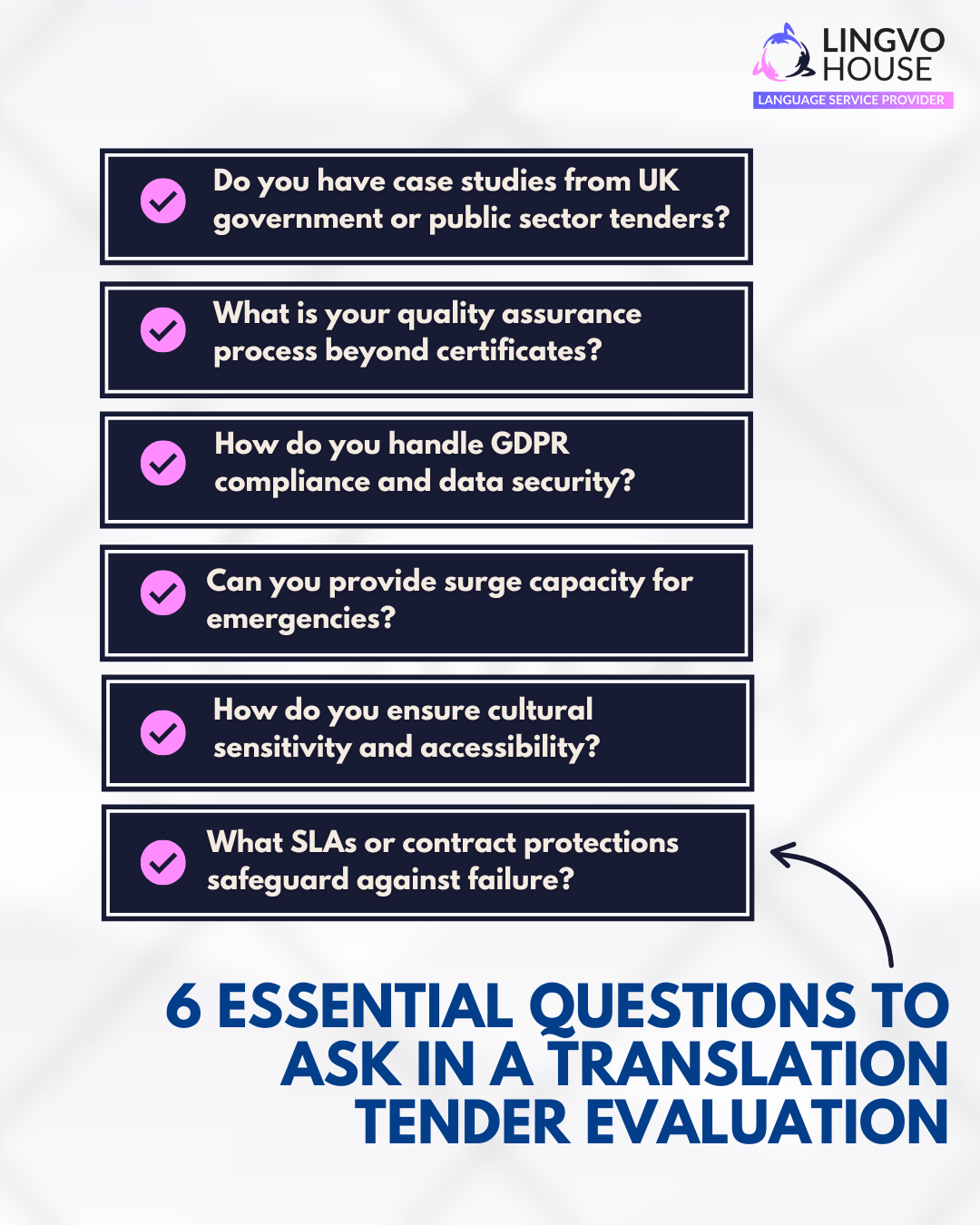
The evaluation process requires asking specific questions that reveal genuine capability rather than generic marketing responses. When assessing translation quality before contract award, procurement officers should demand public sector case studies with specific outcomes and measurable results rather than generic testimonials. Test translations using actual government content rather than generic samples provide objective evidence of quality standards and cultural sensitivity. Quality methodology audits through detailed workflow presentations or site visits reveal whether impressive documentation reflects actual practice.
The choice between freelance translators and agency partnerships depends on factors beyond simple cost comparison. Agencies typically offer accountability structures with clear escalation procedures that individual freelancers cannot match. Business continuity planning prevents single-point-of-failure risks that can derail critical government communications. Liability insurance coverage protects government organisations from risks that individual contractors may not adequately cover. Security protocols meeting government data protection standards require infrastructure investments that most freelancers cannot justify. Quality assurance systems with multiple review layers provide consistency that individual translators may struggle to maintain across large projects.
AI translation capabilities require careful evaluation to distinguish between marketing hype and practical utility for government work. AI translation alone remains insufficient for government communications affecting public safety, legal compliance, or citizen services, but hybrid AI-human workflows can deliver efficiency gains whilst maintaining quality standards. Procurement officers should seek transparent AI disclosure in all quotes and contracts, with human post-editing as standard practice rather than optional enhancement. Quality assurance protocols specifically designed for AI-assisted translation help ensure that efficiency gains don’t compromise accuracy or cultural sensitivity.
Essential certifications create a baseline for evaluation, but procurement officers must understand what different certifications actually guarantee. ISO 17100:2015 for translation services quality management provides framework standards but doesn’t guarantee implementation quality. ISO 9001:2015 quality management systems offer process consistency indicators. UK GDPR compliance creates mandatory data protection standards for government information processing. ISO 27001 information security management and Cyber Essentials certification provide additional security assurance that government work often requires.
Realistic timeframe expectations help procurement officers identify providers making unrealistic promises that typically indicate compromised quality or inadequate resource planning. Emergency communications may require rapid response times, but this capability requires pre-positioned resources and typically involves premium pricing. Policy documents typically require 3-5 days per 1,000 words to allow proper review cycles and stakeholder input. Legal and regulatory documents need 5-10 days per 1,000 words to accommodate legal review and compliance verification. Public communication campaigns require 2-4 weeks to include cultural testing and accessibility format preparation.
Contract protection strategies help procurement officers safeguard their organisations against vendor failures or performance degradation over contract lifecycles. Performance-based contracts with measurable quality metrics create objective standards for evaluation and remediation. Service Level Agreements with financial penalties for failures provide leverage when performance issues arise. Intellectual property clauses protect government content whilst clear termination provisions allow contract exit without excessive penalties when relationships deteriorate.
AI Translation and Emergency Response Requirements for Public Sector
The translation procurement landscape continues evolving as government requirements become more sophisticated and public expectations increase. Sustainability integration reflects growing ESG requirements that affect public sector contracts. Procurement officers increasingly need to evaluate how translation services support government sustainability targets through carbon footprint reduction, local supplier networks, and digital-first workflows that minimise environmental impact. Language demand evolution reflects changing UK demographics and global events that affect community compositions across local authorities and national agencies.
Eastern European languages may see continued demand growth due to ongoing migration patterns whilst Southeast Asian languages support growing business communities in major urban centres. Sign language interpretation requirements continue expanding as accessibility compliance becomes more rigorous and comprehensive. AI integration and governance create new challenges as capabilities rapidly evolve and government policies struggle to keep pace with technological development. Transparent AI usage policies in contracts help ensure that efficiency gains don’t compromise quality or introduce hidden risks. Human oversight requirements for government content maintain accountability standards whilst data security protocols for AI-processed information address emerging privacy concerns.
Regular AI bias auditing and correction procedures help prevent discrimination issues that could trigger compliance violations. Technology requirements for modern government translation continue expanding as digital transformation accelerates across public services. Secure digital infrastructure must include government-grade cloud platforms with UK data residency guarantees. End-to-end encryption for sensitive government communications becomes essential as cyber threats increase in sophistication and frequency. Real-time collaboration tools for multi-stakeholder projects improve efficiency whilst automated compliance reporting reduces administrative burden on procurement teams.
Framework Agreements vs Spot Purchasing for Government Translation Services
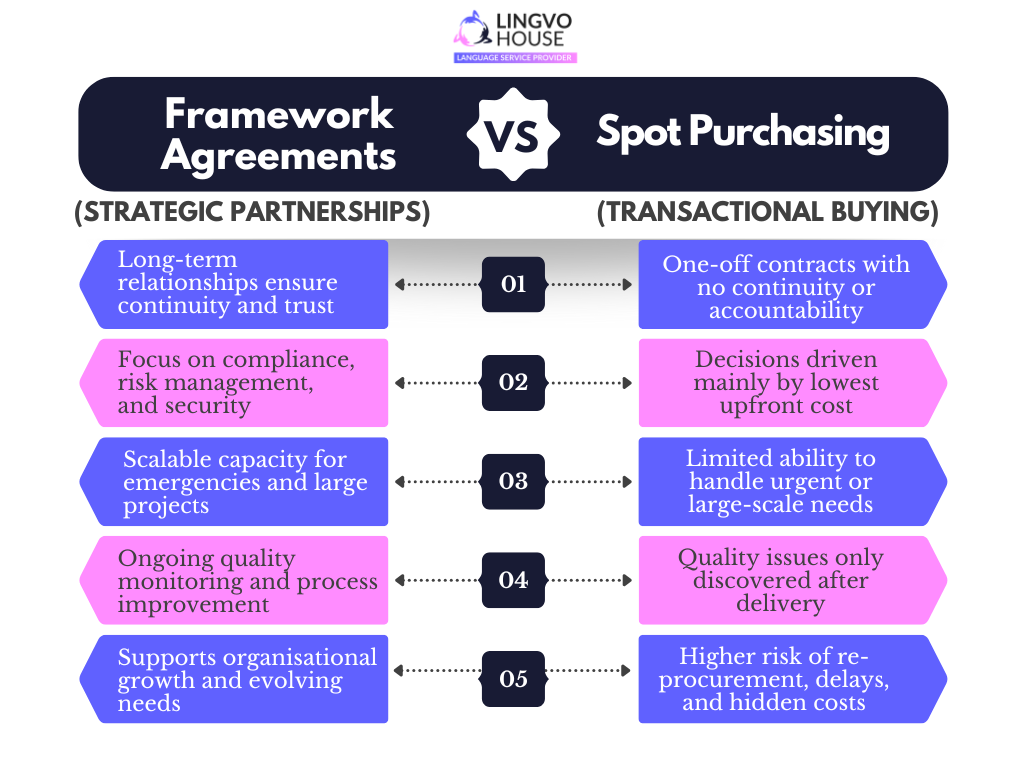
The most successful government organisations approach translation and localisation procurement as strategic partnership development rather than commodity purchasing. This shift reflects growing recognition that accurate, culturally appropriate communication plays a critical role in effective public service delivery. Strategic partnership indicators include consultative communication approaches that go beyond simple order fulfilment. Providers should proactively identify potential translation challenges before they become problems, offer regular strategic reviews and process improvement recommendations, and provide cultural sensitivity guidance for diverse UK community engagement.
Long-term alignment and organisational growth planning help ensure that partnerships can evolve with changing requirements rather than requiring frequent re-procurement exercises. Risk mitigation and compliance excellence separate strategic partners from transactional vendors. Comprehensive risk management requires robust data security protocols that exceed minimum government requirements, business continuity planning with tested backup procedures, and professional liability insurance with adequate coverage for government work. Regulatory compliance excellence demands current certifications with evidence of ongoing monitoring, regular legal and regulatory updates affecting translation requirements, and transparent reporting on compliance metrics and incident management.
The procurement process itself benefits from strategic thinking that considers total cost of ownership, risk mitigation, and long-term partnership potential rather than focusing primarily on initial cost savings. Organisations that successfully navigate translation procurement challenges typically invest time in understanding vendor capabilities, building relationships with account management teams, and establishing performance monitoring systems that support continuous improvement rather than simple compliance checking.
When procurement officers understand these strategic considerations and apply comprehensive evaluation frameworks, they position their organisations for successful translation partnerships that support rather than hinder public service delivery objectives. The investment in thorough procurement processes pays dividends through reduced risk, improved outcomes, and stronger community relationships that effective multilingual communication enables.
When accuracy, compliance, and value matter most, having clarity upfront makes all the difference. Get an instant benchmark with our quick quote here – https://www.lingvohouse.com/quick-quote/