A practical resource for procurement professionals navigating the complexity of global localisation partnerships.
If you’ve ever had to explain to senior leadership why a product launch was delayed because localisation capacity couldn’t scale to meet demand, or why brand messaging became inconsistent across 30 markets because translation workflows broke down, you already understand why building the right LSP partnerships matters more than most procurement decisions.
The challenge is that most procurement approaches treat localisation like any other service — compare capabilities, negotiate rates, manage contracts. This works adequately for standalone projects or limited market expansion. It fails completely when you’re supporting enterprise-scale localisation programmes where speed, consistency, and cultural relevance directly impact revenue and brand credibility.
Why Standard Vendor Management Approaches Fall Short
Let me share a concrete example. A global technology company I worked with had built an impressive in-house localisation team of 15 specialists supporting product launches across 25 markets. Their procurement team had established relationships with six different LSPs, each selected for competitive pricing and basic capabilities.
When they launched their flagship product simultaneously across all markets, the system collapsed. Different LSPs used conflicting terminology for key product features. Review cycles multiplied because external partners didn’t understand internal approval workflows. Content delivery timelines became unpredictable because each LSP managed capacity differently.
The localisation costs? Approximately £180,000 across all markets. The cost of the delayed and inconsistent launch? Over £2.3 million in missed revenue targets, plus months of brand messaging corrections and customer confusion.
This wasn’t poor translation quality in the traditional sense. Each LSP delivered linguistically accurate content. What they lacked was integration into the company’s localisation strategy, understanding of brand voice requirements, and systematic approaches to scaling efficiently.
Here’s what happens in most procurement scenarios: you evaluate LSPs based on their general capabilities, language coverage, and competitive pricing. They demonstrate competence in your sector and provide reassuring case studies. The differences seem manageable, so decisions often come down to cost optimisation or existing relationships.
The real differences only become apparent when demand spikes or complexity increases. Some providers have systematic approaches to terminology management that maintain consistency across hundreds of content pieces. Others handle each project independently. Some integrate seamlessly into enterprise workflows and technology stacks. Others operate as external silos that require constant coordination.
By the time you recognise these differences, you’re usually managing the consequences rather than preventing them.
What Scalable LSP Partnerships Actually Look Like
After working with dozens of organisations on localisation procurement, I’ve identified five characteristics that determine success or failure when scaling enterprise localisation programmes.
(1) Integrated Workflow Architecture, Not Parallel Processing
General translation services operate independently from your internal systems. Scalable LSP partnerships integrate directly into your content management workflows, project tracking systems, and approval processes.
When evaluating providers, examine their actual integration capabilities. Can their project management systems sync with yours to provide real-time visibility into progress and bottlenecks? Do they understand your content creation workflows well enough to advise on optimising source content for efficient localisation? Can they access your terminology databases and style guides directly rather than working from static documents?
Look for evidence of successful workflow integration at similar scales. Ask specific questions about their technology stack and API capabilities. Can they demonstrate how they’ve integrated with enterprises managing similar volumes and complexity? The best providers become extensions of your internal team, not external service providers requiring constant coordination.
(2) Shared Quality Frameworks That Scale Systematically
Standard LSP quality control involves linguistic review and accuracy checks. Scalable partnerships require quality frameworks that maintain brand consistency, cultural relevance, and regulatory compliance across massive volumes and tight timelines.
Examine their quality management systems with particular attention to scalability. How do they maintain terminology consistency when managing 30 simultaneous market launches? What happens when brand guidelines evolve and existing translations need updating across multiple languages? How do they ensure that cultural adaptations remain appropriate as content volumes increase?
The most effective providers use sophisticated quality frameworks that prevent inconsistencies during production, not just during final review. They maintain dynamic terminology databases that flag conflicts automatically. They have documented processes for managing brand evolution across all language versions. They structure review workflows to scale efficiently without compromising standards.
Ask to see their actual quality documentation and scaling methodologies, not just general descriptions. Look for evidence of systematic approaches to managing quality at enterprise scale.
(3) Flexible Capacity Management With Predictable Outcomes
Enterprise localisation demands fluctuate dramatically. Product launches create sudden spikes. Seasonal campaigns require surge capacity. Regulatory changes demand immediate attention across all markets.
Standard LSPs manage capacity reactively, bringing in additional resources when demand peaks. Scalable partners build flexible capacity models that anticipate fluctuations and maintain consistent quality and timelines regardless of volume changes.
Evaluate their capacity management strategies in detail. How do they maintain consistent translator expertise during peak periods? What systems do they use to ensure that surge capacity doesn’t compromise quality or brand consistency? Can they provide dedicated teams for major accounts that scale up and down efficiently?
The best providers maintain core teams familiar with your brand and requirements, supplemented by carefully managed extended networks for peak periods. They use technology and process design to ensure that scaling up doesn’t require starting from scratch with new resources.
(4) Long-term Knowledge Development That Reduces Costs Over Time
Scalable partnerships improve efficiency and quality over time through accumulated knowledge about your organisation, brand requirements, and market needs.
This goes beyond maintaining translation memories and terminology databases. The most valuable providers develop deep understanding of your business priorities, internal processes, and strategic objectives. They can advise on localisation strategy, identify efficiency opportunities, and adapt their services to support your evolving needs.
Evaluate potential providers’ commitment to knowledge development and strategic partnership. Do they invest in understanding your business beyond immediate translation requirements? Are they willing to provide strategic advice and process optimisation recommendations? Do they have dedicated account teams that build institutional memory over time?
Look for evidence of successful long-term partnerships where providers have become strategic advisors rather than just service suppliers. The most valuable relationships involve continuous collaboration and mutual investment in improving outcomes.
(5) Comprehensive Documentation and Performance Management
Enterprise localisation requires detailed documentation for internal stakeholders, audit requirements, and continuous improvement initiatives. Standard LSPs provide basic project reporting. Scalable partners build comprehensive documentation and performance management into their standard operations.
When regulators audit your global compliance communications, when finance teams need to justify localisation investments, or when product teams need to understand market-specific adaptations, you need detailed documentation that goes well beyond translation completion reports.
Examine their documentation and reporting capabilities. Can they provide detailed analysis of quality trends, efficiency improvements, and cost optimisation opportunities? Do they maintain comprehensive audit trails for compliance requirements? Can they produce strategic reports that help you optimise your global localisation programme?
The right providers build extensive documentation into their workflows because they understand that enterprise partnerships require transparency, accountability, and continuous improvement.
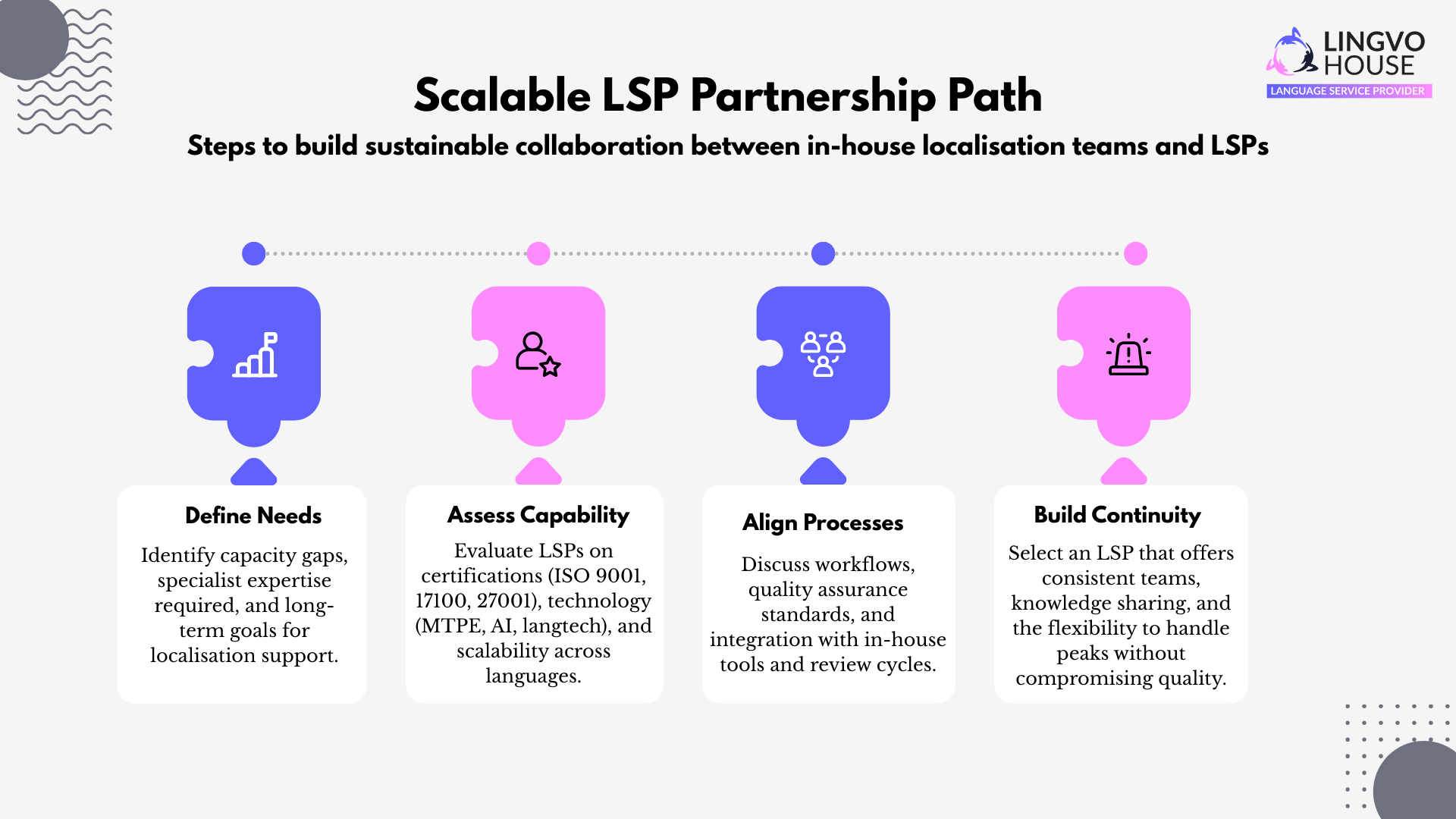
Practical Evaluation Approaches for Procurement Leaders
Start with Strategic Pilot Programmes
Before committing to major partnerships, design pilot programmes that test providers under realistic enterprise conditions. Include your most challenging content types, tightest timelines, and most demanding quality requirements. Involve your actual internal stakeholders and approval processes.
Structure pilots to evaluate not just final translation quality but also project management effectiveness, workflow integration capabilities, and ability to scale efficiently. Include scenarios that test surge capacity, terminology management, and documentation requirements.
Use results to refine your partnership criteria and identify areas where additional process development might be beneficial. The most successful partnerships begin with carefully designed pilots that test real-world capabilities rather than theoretical competencies.
Focus on Total Programme Value, Not Unit Costs
Don’t evaluate purely on per-word translation rates or basic project costs. Consider the total value of achieving your localisation objectives, including internal management time, revision cycles, brand consistency maintenance, and market entry speed.
Slightly higher per-unit costs often result in dramatically lower total programme costs because specialist providers require fewer revision cycles, maintain consistency more effectively, and integrate more efficiently with internal workflows.
Calculate the cost of potential delays, brand inconsistencies, or market entry problems. In most global enterprises, these costs significantly exceed translation expenses, making strategic partnerships excellent investments despite higher unit rates.
Consider value-added capabilities that reduce internal workload and improve strategic outcomes. The best providers become force multipliers for internal localisation teams rather than simple capacity additions.
Structure Contracts for Strategic Partnership Success
Include provisions for workflow integration, quality framework alignment, and capacity scaling in your contracts. Specify documentation requirements and performance measurement standards that reflect strategic partnership objectives, not just transactional service delivery.
Define success metrics that align with your business objectives — market entry speed, brand consistency maintenance, customer satisfaction improvements, internal efficiency gains. Consider pricing structures that align provider incentives with your strategic outcomes.
Build in regular strategic review cycles to assess partnership performance and identify optimisation opportunities. The most successful relationships involve ongoing collaboration, process refinement, and mutual investment in improving results.
Common Procurement Pitfalls to Avoid
Over-reliance on Standard Credentials – Industry certifications and basic qualifications provide useful baselines but don’t guarantee enterprise-scale partnership capabilities. Focus on evidence of successful strategic partnerships and scalable operations.
Underestimating Integration Complexity – Enterprise localisation partnerships require significant workflow integration, technology alignment, and process coordination. Build realistic implementation timelines that accommodate these requirements.
Neglecting Internal Stakeholder Requirements – Your localisation teams, brand managers, product teams, and regional markets have specific requirements and preferences. Involve them in provider evaluation to ensure selected partners can work effectively within your organisation.
Focusing on Cost Optimisation Over Value Creation – Price competition in enterprise localisation often leads to reduced investment in quality systems, workflow integration, or strategic capabilities. The apparent savings rarely justify the operational costs and missed opportunities.
Making the Strategic Decision
When you’ve completed your evaluation, you should have clear evidence about each provider’s integration capabilities, quality frameworks, capacity management systems, and strategic partnership potential. The right choice usually becomes obvious once you focus on these factors rather than just capability comparisons and cost analysis.
Remember that you’re not just procuring translation services — you’re selecting strategic partners who will help your organisation compete effectively in global markets whilst managing complex operational requirements and tight timelines. The best providers understand this responsibility and structure their operations accordingly.
The upfront investment in selecting the right strategic partners pays dividends through improved market entry success, reduced operational complexity, and stronger competitive positioning. More importantly, it enables your internal localisation teams to focus on strategy and optimisation rather than managing multiple vendor relationships and operational challenges.
Take the time to evaluate strategically. The global market stakes are too high to treat this as routine vendor procurement.
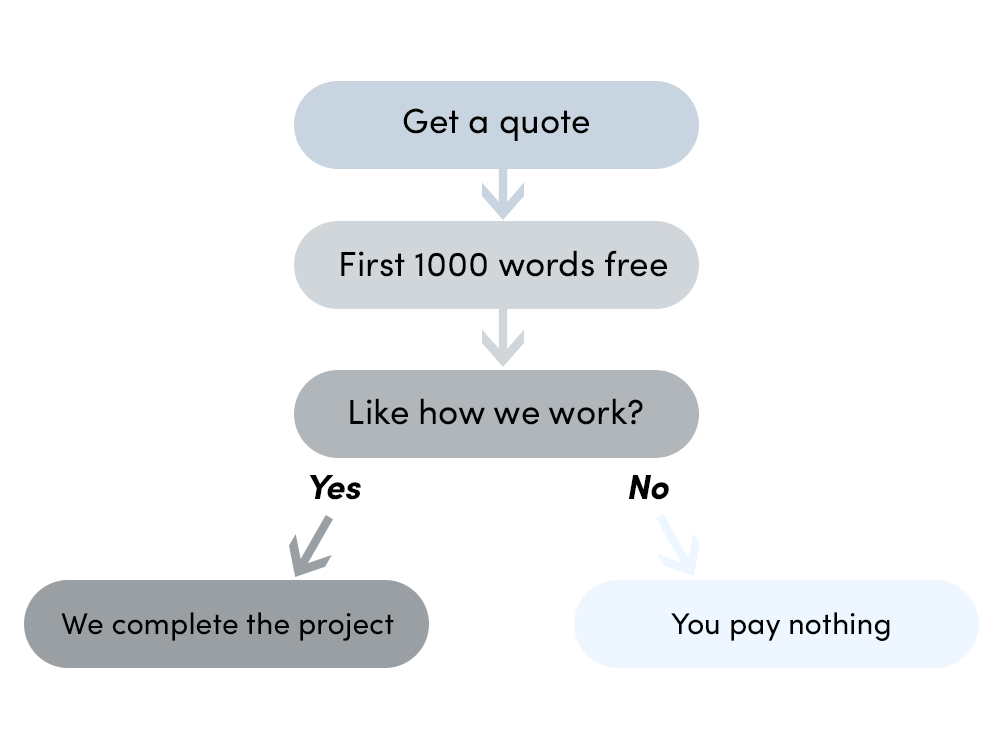
A small step that de-risks the big one: get a quick quote with pricing and schedule assumptions: https://www.lingvohouse.com/quick-quote/