It begins with a single document.
A regulatory submission — perhaps a clinical study report, a prospectus, or a compliance filing for a new market. The source text has been through legal. It has been signed off. It is, as far as your organisation is concerned, complete.
Then it goes to translation.
Somewhere in that process — perhaps through an unmanaged machine translation tool, a freelancer without sector expertise, or an agency that treated your filing like a marketing brochure — a term is rendered incorrectly. A contraindication becomes ambiguous. A liability threshold is misstated. A regulatory deadline is missed because the submission was rejected.
This is not a hypothetical. It is the story that compliance and regulatory officers across pharmaceuticals, financial services and legal departments know intimately — often because they have lived it.
The procurement of language services, in regulated industries, is not an administrative task. It is a risk management decision.
This guide is written for the people who carry that responsibility.
The Stakes Have Changed. Has Your Procurement Framework?
There was a time when translation sat comfortably at the back of operations — a quiet function, managed by executive assistants, invoiced in batches, and reviewed only when something went wrong. That era is over.
Today, the forces reshaping regulated industries have converged on language:
- Simultaneous global market entries demand synchronised, accurate multilingual documentation.
- Regulatory authorities in the EU, US, Middle East and Asia-Pacific operate under distinct — and evolving — documentation standards.
- The proliferation of generative AI tools has created a new category of translation risk: content that looks accurate but is not.
- Data governance expectations — from GDPR to sector-specific confidentiality obligations — now extend into the translation supply chain itself.
In this environment, a poorly structured language services tender does not merely result in a suboptimal supplier. It creates exposure.
The question procurement and compliance teams must ask is no longer simply “Who translates our documents?” It is: “Who is accountable when something goes wrong — and what systems do they have in place to ensure it does not?”
What Regulated Industries Lose When Translation Goes Wrong
For those working in pharma, financial services or legal, the consequences of a translation failure are not abstract. They manifest in precise and painful ways.
Rejected Regulatory Submissions
Regulatory bodies — whether the EMA, the FCA, the MHRA or equivalent authorities in other jurisdictions — do not tolerate ambiguity in translated submissions. A single mistranslated term in a clinical trial document, a product information leaflet or a prospectus can trigger a request for clarification that delays approval by months. In a competitive market, months matter.
Legal Exposure from Terminological Inconsistency
Contracts, compliance policies and regulatory filings must use consistent, jurisdictionally correct terminology across all translated versions. When they do not — because different freelancers, tools or workflows were used at different times — the resulting inconsistencies can be cited by regulators or relied upon as grounds for non-compliance.
Confidentiality Breaches Through Inadequate Supply Chain Controls
When sensitive documents — M&A transaction files, clinical trial data, regulatory submissions — are sent to language service providers without robust data security protocols in place, the risk is not theoretical. Confidentiality must extend to every linguist, every subcontractor, every AI tool in the translation chain.
Reputational Damage
A patient information leaflet that misrepresents dosage guidance. A financial product description that understates risk in a foreign language. These are not merely translation errors. They are reputational events — and in some cases, regulatory investigations waiting to happen.
How to Structure a Translation Tender That Protects Your Organisation
The good news is that the risks above are entirely manageable — provided the procurement process is structured to surface them. Here is what a robust translation RFP must address when regulated documentation is involved.
1. Define Scope with Regulatory Precision
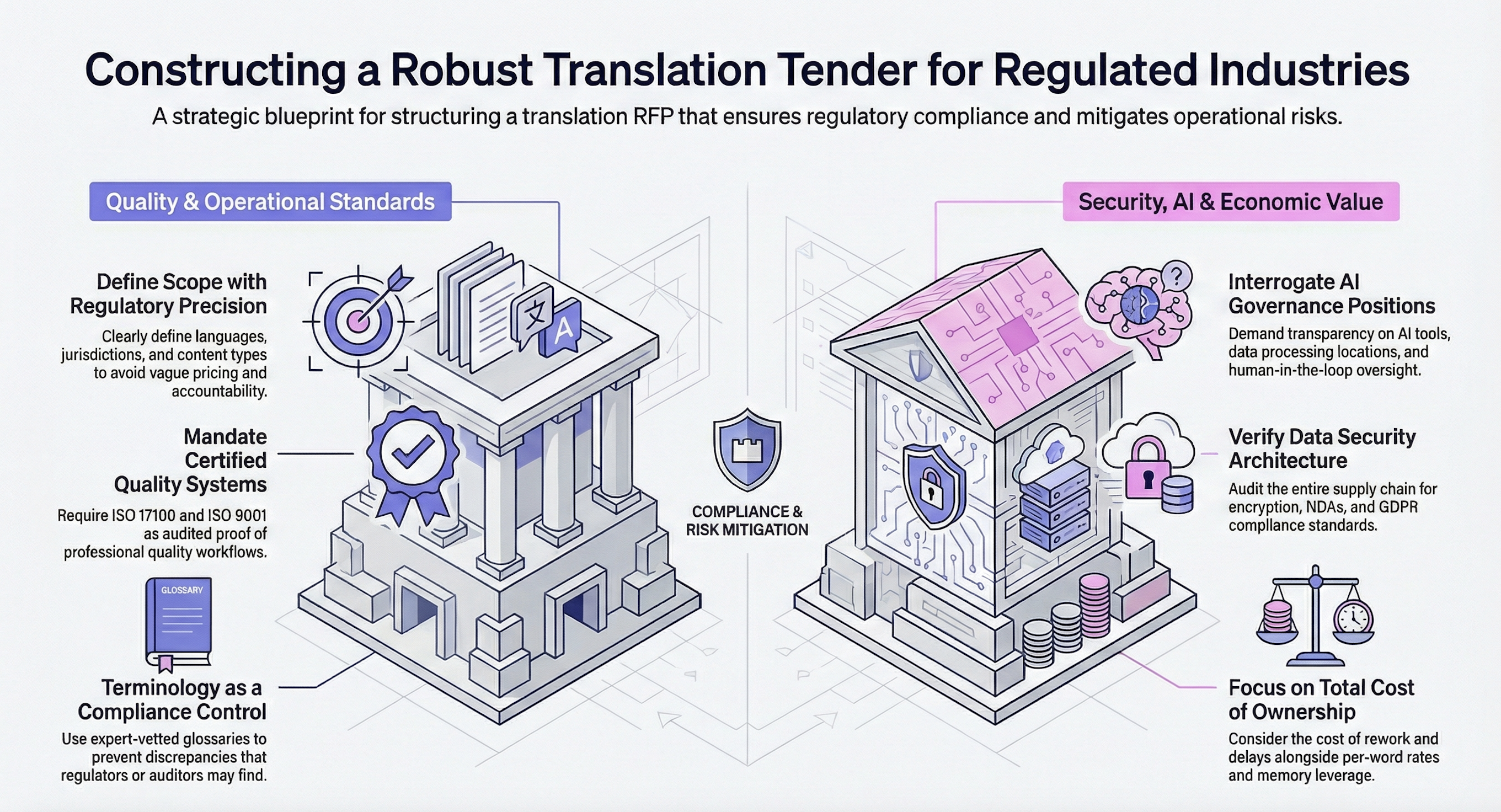
Before approaching any language service provider, your organisation must document its translation requirements with the same rigour it applies to any compliance obligation.
Your scope definition should include:
- All target languages and jurisdictions, with any local regulatory nuance noted.
- A clear taxonomy of content types — regulatory, legal, clinical, marketing, technical — and their respective quality thresholds.
- Estimated annual volumes, with peak periods identified (e.g., new product launches, annual reporting cycles).
- File formats, including whether documents originate from CMS platforms, regulatory submission tools, InDesign, XML or structured data environments.
- Confidentiality classifications — what can be shared, with whom, and under what conditions.
Vague scoping produces vague pricing — and, more dangerously, vague accountability.
2. Require Certified Quality Management Systems
In regulated industries, quality cannot depend on the individual judgement of a single translator. It must be embedded in workflow.
At a minimum, compliant language service providers should hold:
- ISO 17100 certification — the international standard for translation quality management, covering translator qualification, review processes and project workflow.
- ISO 9001 certification — the broader quality management system standard that ensures consistent service delivery.
- Demonstrable sector-specific linguist qualification criteria — a pharmaceutical translation must not be assigned to a linguist whose experience lies in consumer marketing.
These certifications are not box-ticking exercises. They represent external verification that a provider’s quality controls have been independently audited. For compliance officers, they are baseline requirements — not differentiators.
3. Interrogate the AI Governance Position
This is where many tenders fail to ask the right questions.
Machine translation and generative AI have transformed the economics of language services. They can also introduce serious risks when deployed without governance. In regulated industries, the consequences of a hallucination — an AI-generated plausible but factually incorrect output — in a clinical document or a legal filing can be severe.
Your RFP should require prospective providers to address the following directly:
- Which AI or machine translation tools are used, and under what circumstances?
- Where is data processed and stored when AI tools are in use?
- Can AI usage be restricted or disabled for specific project types or document classifications?
- What is the human oversight model for AI-assisted output — who reviews it, with what qualifications, and at what stage?
- What contractual accountability applies if AI-introduced errors reach a final deliverable?
The strongest providers are not those who claim to avoid AI entirely. They are those who can demonstrate that it is governed — and that their clients retain control over how and when it is applied.
4. Evaluate Data Security and Confidentiality Architecture
Every document submitted for translation carries risk. The level of that risk depends entirely on the receiving organisation’s security posture.
A compliance officer evaluating language service providers should ask:
- Does the provider operate secure file transfer protocols — and does this extend to any subcontractor linguists?
- Are NDAs applied throughout the supply chain, not merely at the primary provider level?
- Where is data hosted, and is this compliant with applicable data protection legislation (including GDPR for EU-originating data)?
- Is there an auditable record of who has accessed documents and at what stage?
- How is data destroyed or returned at project completion?
These are not IT questions. They are compliance questions. The procurement team should not be the only function in the room when these answers are evaluated.
5. Assess Terminology Management as a Compliance Control
In regulated industries, terminological consistency is not a stylistic preference. It is a compliance requirement.
When the same concept — a drug interaction, a contractual obligation, a regulatory threshold — is translated differently across different documents or different markets, you do not merely have an inconsistency. You may have a material discrepancy that regulators, auditors or opposing counsel will eventually find.
Effective language service providers manage terminology through structured, maintained glossaries that:
- Are built collaboratively with client subject matter experts.
- Are applied consistently across all translators working on the account.
- Are versioned and auditable.
- Are integrated with translation memory systems to ensure leverage and consistency over time.
Ask prospective providers how they build, maintain and apply terminology databases — and what happens to those assets if the relationship ends.
6. Demand Transparent Pricing That Reflects Total Cost of Ownership
Cost-per-word is a useful metric. It is not a sufficient one.
In regulated industries, the true cost of translation is not the invoice. It is the invoice plus the cost of rework, the cost of delayed regulatory approval, the cost of a compliance escalation, and the cost of rebuilding terminology assets when an underprepared vendor is replaced.
Pricing structures from credible providers should include:
- Clear per-word rates differentiated by content type and quality tier.
- Transparent discounts for translation memory leverage — as your asset base grows, costs should reduce.
- Scalable enterprise or volume models for organisations with predictable ongoing needs.
- No hidden formatting fees for complex document types.
Procurement leaders who select on price alone tend to discover, at the worst possible moment, why that decision was a false economy.
The Human-Technology Balance: What Good Looks Like
There is a persistent misconception in procurement conversations about translation: that choosing between “human translators” and “AI” is the fundamental question.
It is not. The fundamental question is whether the provider has a governed, auditable, quality-assured workflow — and whether that workflow is appropriate for the document in question.
For regulated content, the hierarchy is clear: human expertise leads; technology supports; quality systems govern. A machine can accelerate the production of a first draft. It cannot exercise the regulatory judgement of an experienced pharmaceutical translator who understands the significance of a specific pharmacovigilance term in a given market.
The providers best positioned to serve regulated industries are those who:
- Employ or retain sector-specialist linguists with demonstrable regulatory expertise.
- Operate ISO-certified quality management systems that are externally audited.
- Provide clients with full visibility of their workflow — including who reviewed what, and when.
- Can demonstrate a governance framework for any AI or machine translation tools in use.
- Maintain client-owned terminology and translation memory assets that remain accessible regardless of contract status.
What Compliance Officers Should Anticipate in the Next Three to Five Years
The translation procurement landscape will continue to evolve — and the direction of travel creates both opportunity and obligation for regulated organisations.
Tighter AI Governance Regulation
The EU AI Act and emerging equivalents in other jurisdictions will increasingly require organisations to demonstrate that AI-generated content — including translated documents — has been subject to appropriate human oversight. Your translation supplier’s AI governance position will become a compliance matter in its own right.
Strategic Vendor Consolidation
Organisations managing multiple language service providers across different business units will face increasing pressure to consolidate. Fragmented vendor lists create terminological inconsistencies, data security gaps and audit complexity. Preferred supplier frameworks with a primary, ISO-certified partner will become the norm for regulated industries.
Real-Time Reporting as Standard
Finance and compliance functions will expect live dashboards covering translation spend, project status, quality metrics and volume forecasting. Providers who cannot offer this visibility will not remain on preferred supplier lists.
API-Driven Integration with Regulatory Workflows
Manual email-based submission of translation projects will give way to direct integration between LSP platforms and client regulatory information management systems, CMS environments and electronic document management systems. The most forward-thinking providers are investing in this infrastructure now.
From Risk Event to Competitive Advantage
Translation, when handled strategically, does not merely mitigate compliance risk. It creates commercial advantage.
Organisations that invest in robust language service partnerships — with certified quality systems, governed technology and sector-specialist linguists — move faster through regulatory approvals, maintain terminological consistency across jurisdictions, and build translation memory assets that reduce long-term costs year on year.
Those that do not tend to discover the cost of that decision at precisely the moment they can least afford it.
The difference between a translation function that creates risk and one that prevents it comes down to procurement. Specifically, to the questions asked before a contract is signed.
Work with LingvoHouse
LingvoHouse supports regulated organizations — including NHS Trusts, pharmaceutical companies, legal practices and financial services firms — with ISO-certified translation and localization services.
Our advisors are available to discuss your organisation’s translation requirements, procurement timelines and compliance obligations — without obligation.
To benchmark your current translation model, obtain an instant quote via our platform.