When the Release Is Live and the Docs Are Not
Priya had been planning the European rollout for eight months. The product was ready. The engineering team had signed off. The go-to-market calendar was locked. What nobody had adequately planned for — until six weeks before launch — was the technical documentation.
Help centres, API guides, release notes, onboarding flows, in-app tooltips, compliance disclosures: all of it needed to be localised into six European languages simultaneously. Priya, a Product Localisation Lead at a mid-sized SaaS business, suddenly found herself running an urgent LSP evaluation — not a thorough, considered tender, but the kind of reactive procurement exercise that keeps operational leaders up at night.
She is not alone. Across the SaaS sector, this scenario plays out repeatedly. Translation is deprioritised until it becomes urgent, and urgency is precisely when poor vendor selection carries the highest risk.
Applying translation procurement best practices from the outset — before the pressure mounts — is what separates product teams that scale confidently from those that scramble.
What Is Changing in Localisation Procurement for SaaS
The localisation landscape for software products has shifted considerably in recent years, and the implications for how product teams evaluate language service providers are significant.
Release Cycles Have Accelerated
Where enterprise software once released quarterly or annually, modern SaaS products ship updates weekly or even daily. This creates a fundamentally different demand profile for translation. Localisation is no longer a project; it is a continuous, integrated workflow. An LSP that excels at large, discrete translation projects may struggle to support the agile cadence that SaaS teams operate at.
Technical Documentation Has Become a Compliance Asset
For SaaS businesses operating in regulated markets — fintech, healthtech, legal technology, enterprise software — technical documentation is not merely a support resource. It is a compliance asset. Inaccurate or inconsistent translation of product documentation can create liability, undermine user trust, and in some sectors, trigger regulatory scrutiny.
The AI Question Is Now Unavoidable
Every SaaS product team evaluating an LSP will encounter the AI conversation. Machine translation and generative AI have meaningfully changed what is possible in terms of speed and cost — but they have also introduced new governance questions. For technical documentation specifically, where precision and terminology consistency are non-negotiable, understanding how an LSP manages AI-assisted workflows is a central part of any credible evaluation.
These shifts mean that localisation procurement best practices for SaaS are not simply a scaled-down version of enterprise translation tendering. They require their own framework.
The Procurement Challenges That Derail SaaS Localisation Projects
Product localisation leads face a distinctive set of challenges when evaluating LSP capabilities. Understanding them clearly is the first step to building a procurement approach that avoids the most common failure points.
Terminology Drift Across Releases
One of the most persistent problems in SaaS technical documentation translation is terminology inconsistency. When a product evolves rapidly and multiple translators or teams work across different releases without centralised oversight, terms shift. A feature called one thing in version one is described differently in version three. For end users, this creates confusion. For compliance teams, it can create real risk.
A mature LSP will demonstrate how they manage and maintain terminology assets — translation memories, glossaries, style guides — across your product’s lifecycle. This is not optional infrastructure; it is the foundation of quality at scale.
Integration With Existing Development Workflows
Product teams do not operate through email attachments and Word documents. They work within content management systems, developer platforms, and continuous localisation pipelines. An LSP that cannot integrate with these environments — or that requires manual file handling — will become a friction point that slows release velocity.
When evaluating LSP capabilities for technical documentation translation, the ability to connect with tools such as content management systems, version control environments, or localisation platforms is a practical necessity, not a premium feature.
Balancing Speed With Linguistic Accuracy
Technical documentation demands precision. A mistranslated parameter, an ambiguous error message, or an incorrectly localised safety warning can cause genuine problems for users — and for the business. Yet product teams are under constant pressure to ship fast.
The right LSP will have a clear, documented approach to this tension: defined content tiers, appropriate workflows for different risk levels, and quality assurance processes that do not create unnecessary delays. Vague commitments to “high quality” are not sufficient. Procurement leaders should ask for specifics.
A Practical Framework: How to Run an LSP Evaluation for Technical Documentation
Applying structured language service provider evaluation criteria is what distinguishes a considered procurement decision from a reactive one. Below is a practical translation RFP checklist adapted for SaaS technical documentation contexts.
Define Scope Before You Issue the Brief
Before approaching any LSP, product teams should map:
-
Total volume estimates by language pair and content type (help centre, API docs, UI strings, compliance content)
-
Release frequency and expected turnaround requirements
-
Integration requirements (CMS, developer platforms, localisation tools)
-
Internal stakeholder responsibilities across product, engineering, legal and marketing
Ambiguity at the scoping stage invariably results in inflated quotes, missed expectations, and difficult conversations further down the line.
Translation RFP Checklist for SaaS Technical Documentation
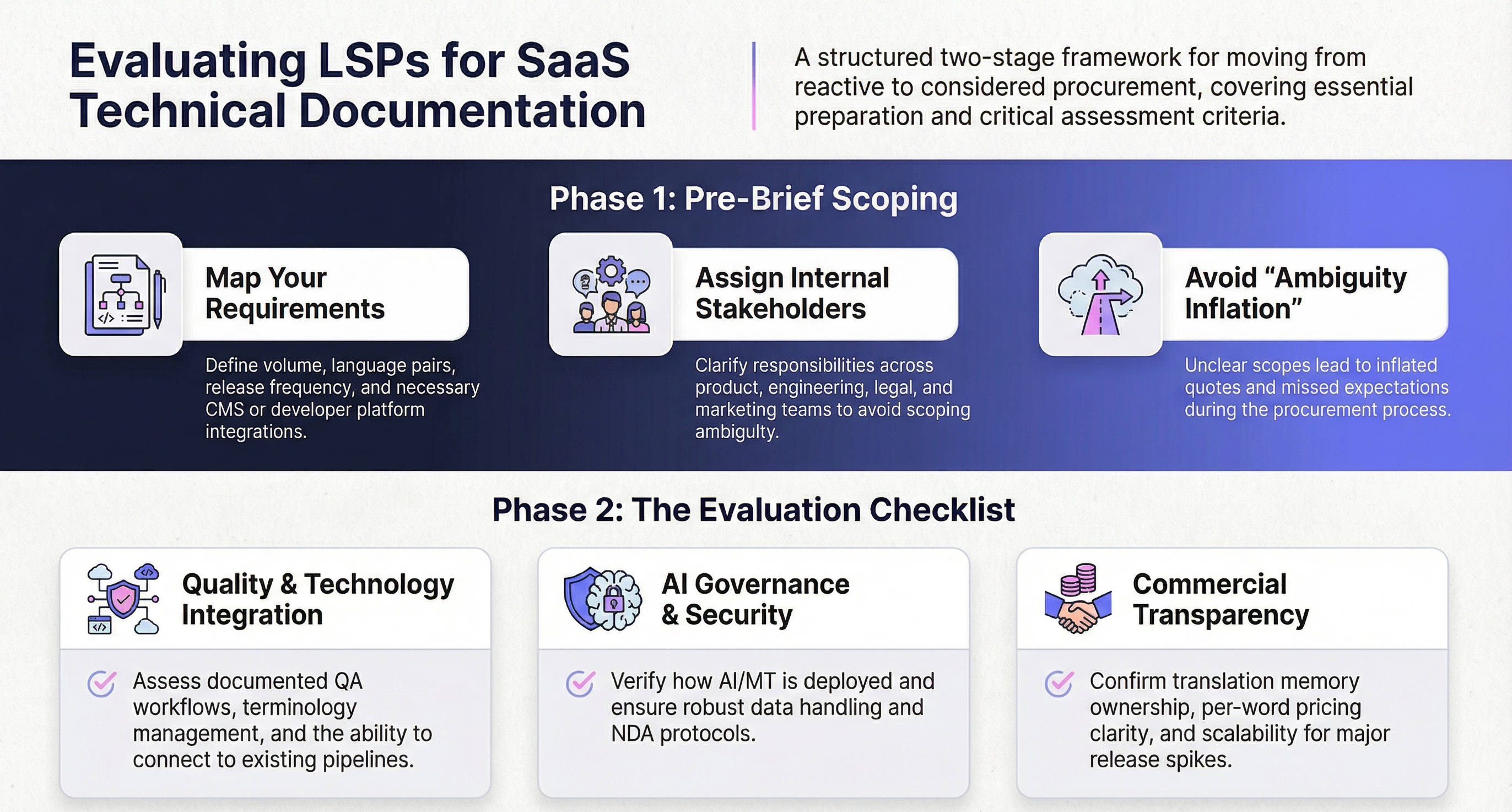
When issuing a request for proposal or conducting an LSP evaluation, use the following as a baseline:
- Quality assurance process: Can the LSP describe a documented workflow from file receipt to final delivery, including editing, proofreading and QA stages?
- Terminology management: Do they maintain and update client-specific glossaries and style guides across releases?
- Translation memory ownership: Who owns the translation memory, and how is it leveraged to reduce costs over time?
- Technology integration: Can they connect with your existing content pipeline? What integration options are available?
- AI governance: How do they deploy machine translation or AI assistance? What human review is applied, and to which content types?
- Scalability: How do they handle volume spikes around major releases? Is there a dedicated team or project manager?
- Confidentiality and data handling: What security protocols apply to product documentation? How are NDAs and data processing agreements managed?
- Pricing transparency: Are per-word rates clearly structured, with visibility into translation memory discounts, minimum charges, and billing flexibility?
Running a small pilot project before committing to a full engagement is also advisable. Written proposals reveal polish; real delivery under time pressure reveals capability.
Balancing AI and Human Expertise Without Increasing Risk
For SaaS product teams, the AI question in localisation is not whether to use it — it is how to use it responsibly, and which content types warrant which approach.
A sensible content tiering strategy might look like this: high-volume, lower-risk content such as release notes, changelog entries, and internal documentation may be well-suited to AI-assisted translation with a lighter human review process. Regulated content, customer-facing onboarding materials, legal disclosures, and UI copy in high-stakes workflows typically warrant full human translation with structured review.
The key governance question for procurement is: does the LSP make this distinction clearly and systematically, or do they apply the same workflow to all content regardless of risk? Mature providers will have a documented approach to content classification and workflow allocation. Those that cannot articulate this should prompt further scrutiny.
Terminology control is also central to responsible AI integration. Translation memories and glossaries that are well-maintained and regularly updated allow AI-assisted workflows to produce more consistent output — which in turn reduces the burden on human reviewers. Without this infrastructure, AI can accelerate inconsistency as readily as it accelerates throughput.
What Good Looks Like: Signals of a Mature LSP for SaaS Localisation
Evaluating LSP capabilities for technical documentation translation goes beyond checking a capability list. It requires reading the structural signals that indicate genuine operational maturity.
A provider worth serious consideration will be able to speak confidently about how they have managed terminology drift across multi-year client relationships. They will have a clear view on how their technology infrastructure connects with client environments, and they will be willing to demonstrate it. They will describe their quality assurance process in specifics — not generalities — and they will be transparent about where AI is and is not deployed in their workflows.
Commercially, mature LSPs offer pricing models that reward long-term partnership: translation memory leverage that reduces costs as the relationship develops, clear reporting on efficiency gains, and billing structures that reflect the ongoing nature of SaaS localisation rather than treating every release as a one-off project.
On confidentiality, expect documented processes around data handling, not verbal assurances. For SaaS businesses handling user data or operating in regulated sectors, this is a non-negotiable area of due diligence.
Conclusion: Turning Complexity Into Confidence
Priya’s rollout did go ahead. But it was closer than it needed to be, and the reactive vendor selection created pressures — on quality, on timelines, on stakeholder trust — that a more structured approach would have avoided.
Translation procurement best practices for SaaS product localisation are not about adding bureaucracy to an already complex release process. They are about making partner selection a deliberate decision rather than an emergency one. When the evaluation criteria are clear, when the RFP is well-structured, and when AI governance and terminology management are treated as core requirements rather than afterthoughts, the right LSP becomes much easier to identify — and the working relationship is far more productive from day one.
Choosing the right language service provider for technical documentation translation is, ultimately, a strategic decision. It affects release velocity, compliance posture, user experience, and the credibility of your product in every market you enter.
If you are in the process of evaluating LSP capabilities and would like a second perspective on your criteria or process, the advisors at LingvoHouse are happy to have that conversation. Alternatively, if you would like to benchmark costs and turnaround for your documentation volumes, you can get an instant quote via our platform — a straightforward starting point for any structured procurement exercise.