Their German market launch — eighteen months in the planning — was dead in the water. Regulatory documentation contained fundamental translation errors that weren’t just embarrassing; they were compliance violations. The “cost-effective” vendor had delivered technically accurate translations that completely missed the regulatory nuance. The result? A £200,000 rework, three-month delay, and a very uncomfortable conversation with the CEO about how procurement decisions directly impact strategic business outcomes.
Emma’s story isn’t unique. It’s the wake-up call that’s reshaping how forward-thinking procurement professionals approach translation and localisation procurement in 2025.
Translation Procurement Checklist: Moving Beyond Cost-Per-Word in Vendor Selection
For decades, translation lived in the procurement equivalent of the bargain bin. Cost-per-word comparisons ruled supreme, with buyers treating language services as a commodity purchase — much like office supplies or catering. This approach made sense when translation was primarily about brochures and basic marketing materials.
Today’s reality is starkly different. Translation has become mission-critical infrastructure for global business operations. When CSA Research reveals that 76% of consumers prefer purchasing in their native language, and 40% simply won’t buy from foreign-language websites, we’re not talking about nice-to-have marketing polish. We’re talking about fundamental market access.
The procurement implications are profound. What was once a routine purchasing decision now directly influences compliance posture, market entry speed, customer acquisition costs, and brand reputation in international markets.
Hidden Costs of Cheap Translation Procurement: Why Lowest Per-Word Pricing Backfires
The finance director’s favourite metric — lowest cost per word — has become procurement’s most dangerous false economy. The hidden costs of this approach are staggering and often don’t surface until it’s too late.
Consider the regulatory translation market. A pharmaceutical company selecting a general translation provider might save 40% on initial costs. When that provider lacks sector-specific expertise in drug labelling requirements, the resulting compliance failures can trigger regulatory investigations, product recalls, and market access delays measured in years, not months.
In the SaaS sector, poor localisation can cripple user adoption. A customer relationship management platform that spent £15,000 on professional localisation might see 300% faster market penetration compared to a competitor that spent £8,000 on basic translation but delivered a user experience that feels foreign and awkward to local users.
The procurement lesson is clear: optimising for initial cost rather than total value creation is a strategic mistake with measurable business consequences.
Translation Procurement KPIs: How Speed-to-Market Defines Vendor Value
Modern procurement teams are increasingly evaluated on their ability to enable business agility, not just cost reduction. In translation procurement, this means prioritising partners who can compress time-to-market cycles whilst maintaining quality standards.
This requires a fundamental shift in vendor evaluation criteria. Traditional RFPs focus heavily on linguistic qualifications and cost structures. Strategic procurement processes now prioritise operational capabilities: workflow automation, API integrations, real-time project visibility, and scalable resource allocation.
The most successful global launches happen when translation workflows integrate seamlessly with existing content management systems, providing transparency and automation that eliminate manual handover bottlenecks. Procurement teams that understand this deliver measurable competitive advantages through accelerated market entry.
How to Ensure Translation Quality for Regulatory Compliance
For procurement professionals in regulated industries — finance, pharmaceuticals, medical devices, aerospace — translation quality isn’t about customer satisfaction. It’s about regulatory compliance and legal liability.
The baseline requirement of ISO 17100 certification tells procurement teams that a provider understands professional translation standards. But the most sophisticated buyers dig deeper, evaluating sector-specific expertise, compliance track records, and quality assurance protocols that can withstand regulatory scrutiny.
This approach transforms translation procurement from a cost exercise into a risk management discipline. The question isn’t “Who can translate this cheapest?” but “Who can deliver translations that will pass regulatory review, support compliance objectives, and minimise legal exposure?”
How to Evaluate Translation Vendors for Human and AI Workflow Integration
The future of translation procurement lies in the intelligent deployment of hybrid human-AI workflows. Procurement teams that understand this deliver both cost efficiency and quality excellence by matching the right approach to the right content type.
High-volume, low-risk content benefits from Machine Translation Post-Editing (MTPE), delivering speed and cost efficiency for internal communications, basic product descriptions, and routine documentation.
Mission-critical materials — regulatory filings, customer-facing communications, legal documents — require expert human translation with rigorous quality assurance protocols.
The procurement challenge isn’t choosing between human and machine translation. It’s selecting partners who can intelligently orchestrate both approaches through sophisticated workflow management that optimises for quality, speed, and cost across diverse content types.
How to Build a Strategic Framework for Evaluating Translation Vendors
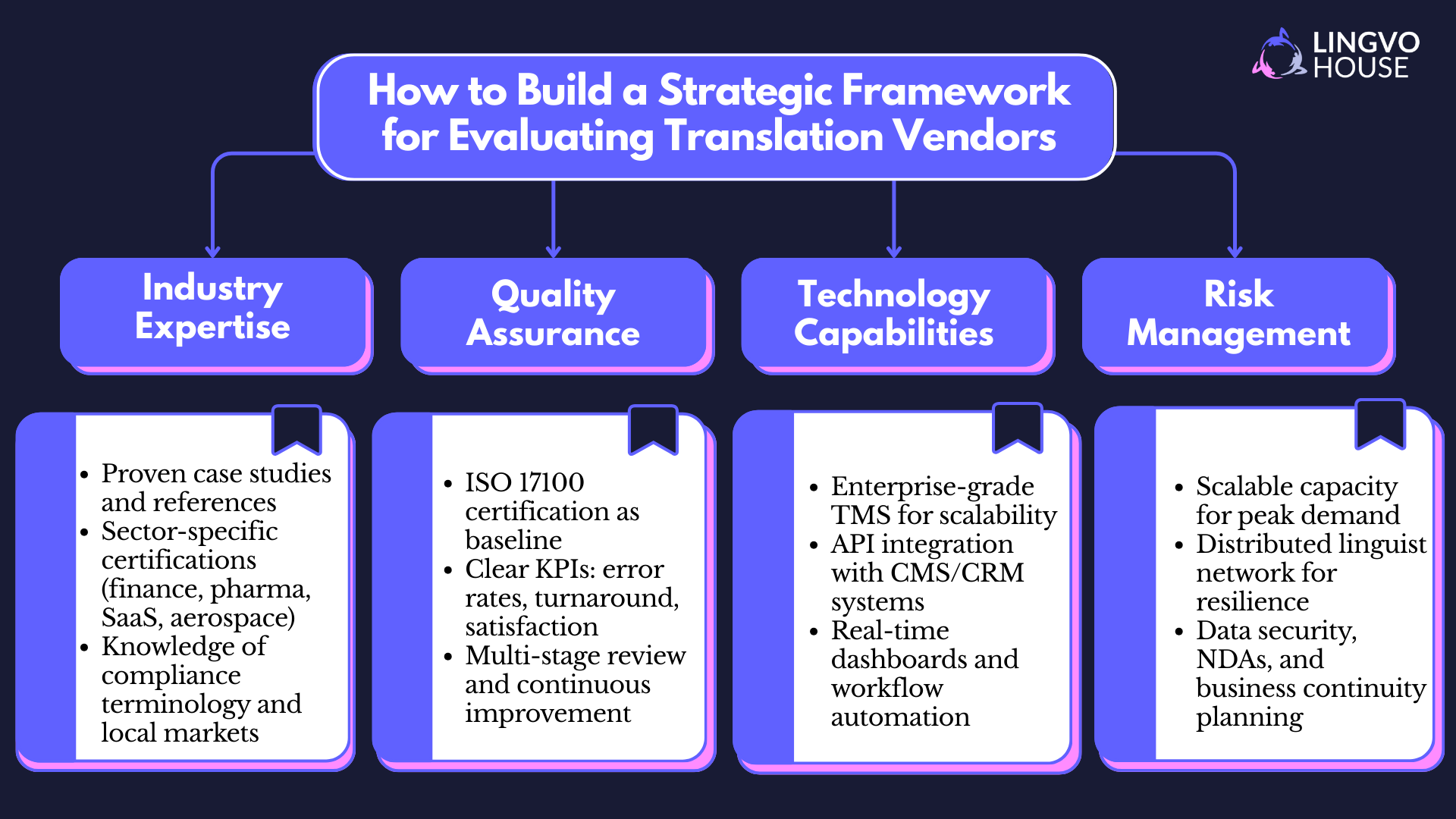
Forward-thinking procurement teams are moving beyond traditional RFP templates to evaluate translation partners across four critical dimensions:
Industry Expertise: Proven case studies, regulatory certifications, and domain-specific knowledge that align with your sector’s compliance requirements and market dynamics.
Quality Assurance: ISO-certified processes, measurable KPIs, continuous improvement protocols, and demonstrated ability to maintain consistency across high-volume projects.
Technology Capabilities: Translation management system sophistication, API integration capabilities, automation infrastructure, and scalability that supports enterprise-level operations.
Risk Management: Proven ability to handle volume surges, distributed supply chain resilience, data security protocols, and business continuity planning.
This framework shifts procurement evaluation from “Can they translate?” to “Can they enable our global business strategy?”
How to Calculate the Total Cost of Ownership in Translation Procurement
The most common procurement mistake in translation is over-reliance on unit cost comparisons. The real metric should be total cost of ownership (TCO), which includes hidden expenses that often dwarf initial savings.
Revision costs from poor initial quality, integration expenses for incompatible systems, opportunity costs from missed deadlines, and regulatory rework expenses can easily exceed 300% of initial translation costs.
Premium language service providers may appear costlier in initial procurement comparisons but frequently deliver lower TCO through reduced retranslation requirements, accelerated market access, compliance risk avoidance, and superior customer experience outcomes that drive higher local market adoption rates.
Strategic procurement teams calculate ROI by including time-to-market acceleration, compliance risk mitigation, and customer experience improvements in their vendor selection criteria.
How Procurement Can Drive Business Growth Through Strategic Translation Partnerships
The organisations succeeding in global markets treat translation procurement as a strategic capability, not an administrative function. They understand that localisation partnerships can become competitive differentiators that accelerate international expansion and reduce market entry risks.
This approach requires procurement professionals to think beyond traditional vendor management towards strategic partnership development. The most successful international expansions happen when procurement teams select partners who align operational capabilities with business growth objectives, providing scalable infrastructure that supports rapid geographic expansion.
The transformation is already happening. Progressive procurement teams are embedding localisation strategy into their broader supplier relationship management frameworks, treating translation partners as essential business enablers rather than tactical service providers.
How to Optimise Vendor Selection for Translation and Localisation
As we observe Procurement Month, translation procurement deserves serious strategic attention. The decisions made in vendor selection, contract structuring, and partnership development directly influence international market success, regulatory compliance, and customer acquisition outcomes.
The question for procurement professionals isn’t whether to prioritise cost or quality — it’s how to structure partnerships that deliver both efficiency and effectiveness in supporting global business objectives.
The companies that master this balance will turn localisation into a competitive advantage. Those that don’t will continue learning expensive lessons about the true cost of procurement shortcuts.
Ready to transform your translation procurement strategy? Speak to our enterprise solutions team to discover how strategic localisation partnerships can support your global growth objectives with seamless workflows, scalable technology, and uncompromising quality. https://www.lingvohouse.com/technology-translation/