It usually starts with a phone call.
The regulatory team needs the entire submission package translated into German and French. The deadline is three weeks away — non-negotiable because the regulatory window closes then. The CFO is asking questions about the budget. And somehow, you need to find a translation partner who won’t become the reason a multi-million-pound project gets delayed.
If you’ve been in procurement long enough, you’ve probably been in this position. The translation decision that initially seemed routine suddenly carries enormous weight. Because in regulated industries, choosing the wrong translation partner doesn’t just mean poor quality — it means compliance failures, audit problems, and projects that stall just when they should be crossing the finish line.
The challenge is that most procurement processes aren’t designed for this reality. We’re trained to compare costs, evaluate credentials, and negotiate terms. This works perfectly well for most services. It fails spectacularly when the stakes are regulatory compliance and the consequences of failure compound exponentially.
When Standard Procurement Logic Breaks Down
Let me share a story that illustrates why traditional procurement approaches miss the mark in regulated translation.
A medical device company we worked with had developed an innovative cardiac monitoring system. After five years of development and testing, they were ready for CE marking across European markets. The technical documentation package needed translation into German, French, Italian, and Spanish — about 200,000 words of highly technical regulatory content.
Following standard procurement practice, they requested quotes from six translation companies. All claimed medical device expertise. All provided competitive pricing. All promised on-time delivery. The differences seemed minimal, so they selected based primarily on cost — a decision that saved them about £8,000 compared to the next-lowest bidder.
The problems emerged during delivery. The translations were linguistically accurate but showed troubling inconsistencies in technical terminology. The same component was called by three different names across the German documents. Critical safety warnings used varying language that could confuse end users. Most concerning, some translated content didn’t align with the strict formatting requirements European regulators expect.
The regulatory consultants flagged these issues immediately. Fixing them required extensive revision cycles, delayed the CE marking submission by four months, and ultimately cost more than £150,000 in lost revenue opportunities — all to save £8,000 in translation costs.
This wasn’t a case of poor translation quality in the obvious sense. The translators were qualified linguists with medical backgrounds. What they lacked was deep understanding of how regulatory reviewers evaluate translated content, why terminology consistency matters across related documents, and how translation choices affect approval timelines.
The real tragedy? These issues were entirely preventable with the right procurement approach.
What Actually Distinguishes Strategic Translation Partners
After working with dozens of organisations navigating regulated translation procurement, I’ve learned that five factors separate strategic partners from commodity providers.
(1) Regulatory Process Understanding, Not Just Subject Matter Expertise
Many translation companies claim expertise in pharmaceuticals, medical devices, or financial services. Far fewer understand how regulatory submission processes actually work. There’s a crucial difference between translating medical content and translating medical content for regulatory submission. A translator might perfectly understand clinical terminology but completely miss the implications of inconsistent labeling across related documents. They might translate financial disclosures accurately but format them in ways that create compliance concerns.
When evaluating potential partners, ask specific process questions. Can they explain how terminology decisions in clinical protocols affect regulatory review timelines? Do they understand why consistent formatting matters in financial disclosure documents? Have they worked with regulatory consultants to resolve translation-related submission issues? Look for evidence of genuine regulatory experience, not just sector knowledge. The best providers have worked directly with regulatory teams. They understand review processes from the regulator’s perspective. They know which translation choices create problems downstream and how to avoid them.
(2) Quality Systems Designed for Audit Requirements
Standard translation quality control focuses on linguistic accuracy and readability. Regulated translation requires systematic approaches that create audit-ready documentation while preventing compliance-related errors. The difference is fundamental. Commercial translation quality control asks: “Is this accurate and well-written?” Regulated translation quality control asks: “Is this accurate, consistent across related documents, compliant with regulatory requirements, and fully documented for audit purposes?”
Examine potential partners’ quality management approaches in detail. How do they maintain terminology consistency across hundreds of related documents? What happens when regulatory requirements change mid-project? How do they document translation decisions for audit purposes? The most sophisticated providers use advanced terminology management systems that flag inconsistencies during translation, not just during final review. They maintain detailed audit trails that satisfy regulatory documentation requirements. They train reviewers to evaluate regulatory compliance alongside linguistic accuracy. Ask to see actual examples of their quality control documentation. Look for evidence of systematic error prevention rather than just error detection.
(3) Information Security That Matches Regulatory Requirements
Regulated content often contains extraordinarily sensitive information. Clinical trial data that competitors would pay millions to access. Financial strategies that could affect market valuations. Proprietary research that represents years of competitive advantage. Standard confidentiality agreements aren’t sufficient. You need partners with information security infrastructure that matches your internal requirements.
Evaluate their security capabilities with the same rigor you apply to IT vendors. How do they encrypt files during transmission and storage? Who has access to your content, and how is that access controlled and monitored? Can they provide detailed audit trails showing who handled your documents and when? Consider their physical security measures, particularly for providers with multiple office locations. Some regulated content requires background checks for anyone with access. Many organisations require on-shore data handling for sensitive regulatory documents. Make sure potential partners can accommodate these requirements without compromise.
(4) Long-term Partnership Capability
Regulated translation benefits enormously from continuity. Partners who work with your organisation over time develop understanding of your specific terminology preferences, regulatory approaches, and internal review processes. This continuity translates into measurable improvements in both quality and efficiency. Experienced partners anticipate potential issues before they become problems. They maintain consistency across related projects spanning months or years. They understand your internal stakeholder requirements and adapt their workflows accordingly.
When evaluating providers, look for evidence of genuine partnership orientation. Do they invest time in understanding your specific requirements? Are they willing to adapt their processes to match your needs? Do they have dedicated resources for major accounts? The best partnerships involve ongoing collaboration and process refinement. Look for providers who view your success as directly linked to their own.
(5) Comprehensive Documentation Capabilities
When regulators audit your submissions, they expect detailed documentation of all translation decisions. Who translated specific sections? What reference materials were used? How were terminology questions resolved? Who reviewed the final output? Many translation providers can’t produce this documentation after the fact. They rely on informal processes that work adequately for routine projects but fail completely under regulatory scrutiny.
Strategic partners build audit trail documentation into their standard workflows. They maintain detailed records of translator qualifications, review processes, and decision rationales. They can produce comprehensive documentation packages that satisfy regulatory audit requirements. Ask potential partners about their audit support capabilities. Can they provide detailed process documentation? Have they successfully supported regulatory audits for other clients? What documentation do they provide as standard, and what requires special arrangements?
(6) Practical Evaluation Approaches That Actually Work
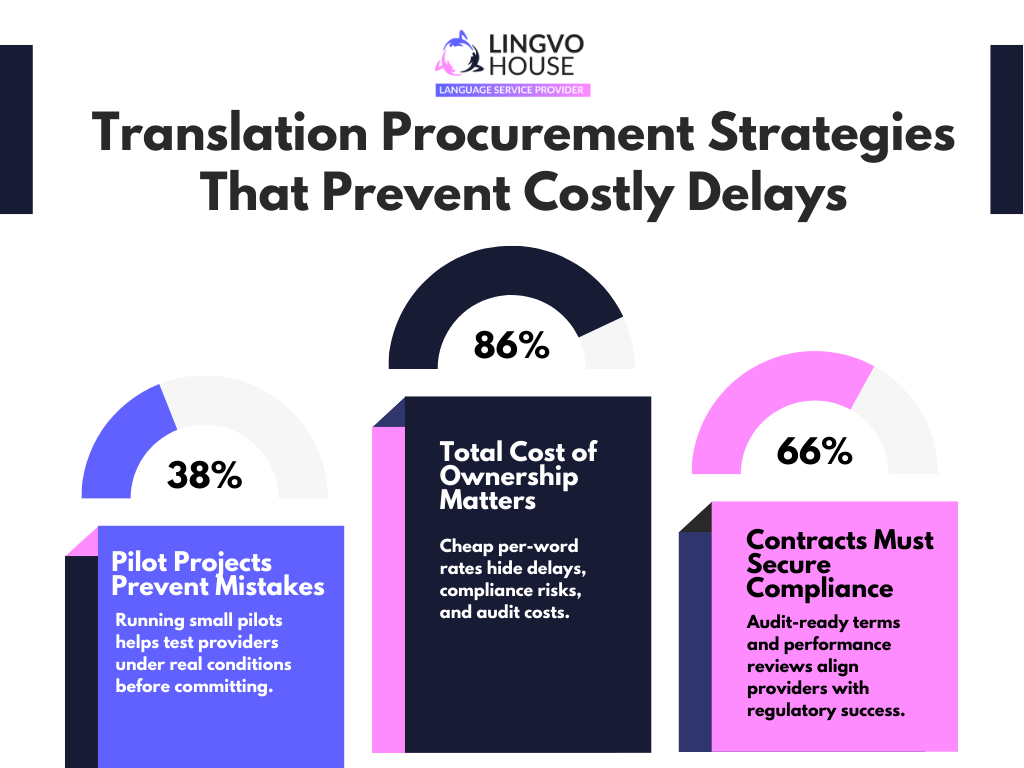
Start with Pilot Projects: Before committing to major contracts, run pilot projects that test providers under realistic conditions. Include your most challenging content types and tightest deadlines. Involve your actual internal review processes and stakeholders. Structure pilots to evaluate project management effectiveness and responsiveness to feedback, not just final translation quality. Include your documentation requirements and audit trail needs in the pilot scope. Use pilot results to refine your selection criteria and identify areas where additional process development might be beneficial.
Focus on Total Cost of Ownership: Don’t evaluate purely on per-word translation costs. Consider the total cost of achieving acceptable final results, including internal review time, revision cycles, potential regulatory delays, and audit documentation requirements. In most regulated industries, the cost of delays or compliance issues dwarfs translation expenses, making specialist providers excellent value despite higher per-word rates. Calculate realistic scenarios for different types of provider failures. What does it cost when inconsistent translations delay regulatory approval? How much management time gets consumed fixing preventable quality issues? What are the audit implications of inadequate documentation?
Structure Contracts for Regulatory Success: Include provisions for regulatory audit support in your contracts. Specify documentation requirements and audit trail standards. Define quality metrics that reflect regulatory compliance, not just linguistic accuracy. Consider pricing structures that align provider incentives with your success. Fixed-price arrangements for defined scopes encourage efficiency while maintaining quality standards. Build in regular performance review cycles to assess effectiveness and identify improvement opportunities. The best relationships involve continuous collaboration and process refinement.
Common Pitfalls That Catch Experienced Procurement Teams
Over-reliance on Industry Certifications – ISO certifications and similar credentials provide useful baselines but don’t guarantee regulatory expertise. Focus on evidence of actual regulatory experience and successful project outcomes.
Underestimating Timeline Requirements – Regulated translation often requires significantly more time than commercial work because of additional review stages, regulatory compliance checks, and documentation requirements. Build realistic timelines that accommodate these requirements.
Neglecting Internal Stakeholder Needs – Your regulatory affairs teams, clinical operations groups, and legal counsel have specific requirements and preferences. Involve them in provider evaluation to ensure selected partners can work effectively with your internal processes.
Focusing Purely on Cost Competition – Aggressive cost competition in regulated translation often leads to corner-cutting in quality assurance or the use of less experienced translators. The savings rarely justify the risks.
Making the Strategic Decision
When you’ve completed your evaluation, you should have clear evidence about each provider’s regulatory expertise, quality systems, security capabilities, and documentation standards. The right choice usually becomes obvious once you focus on these factors rather than cost comparisons alone. Remember that you’re not just procuring translation services — you’re selecting a strategic partner who will help you navigate complex regulatory requirements while managing sensitive information and tight deadlines. The best providers understand this responsibility and structure their operations accordingly. They invest in regulatory expertise, maintain sophisticated quality systems, and provide the documentation capabilities regulatory success requires.
The upfront investment in choosing the right partner pays dividends through improved regulatory outcomes, reduced revision cycles, and stronger audit documentation. More importantly, it helps you avoid the costly delays and compliance failures that result from treating regulated translation as a commodity purchase. Take the time to evaluate properly. In regulated industries, the stakes are too high to treat translation partner selection as routine vendor selection. The phone call with the urgent regulatory deadline will come again. When it does, having the right strategic partner already in place transforms crisis management into confident execution.
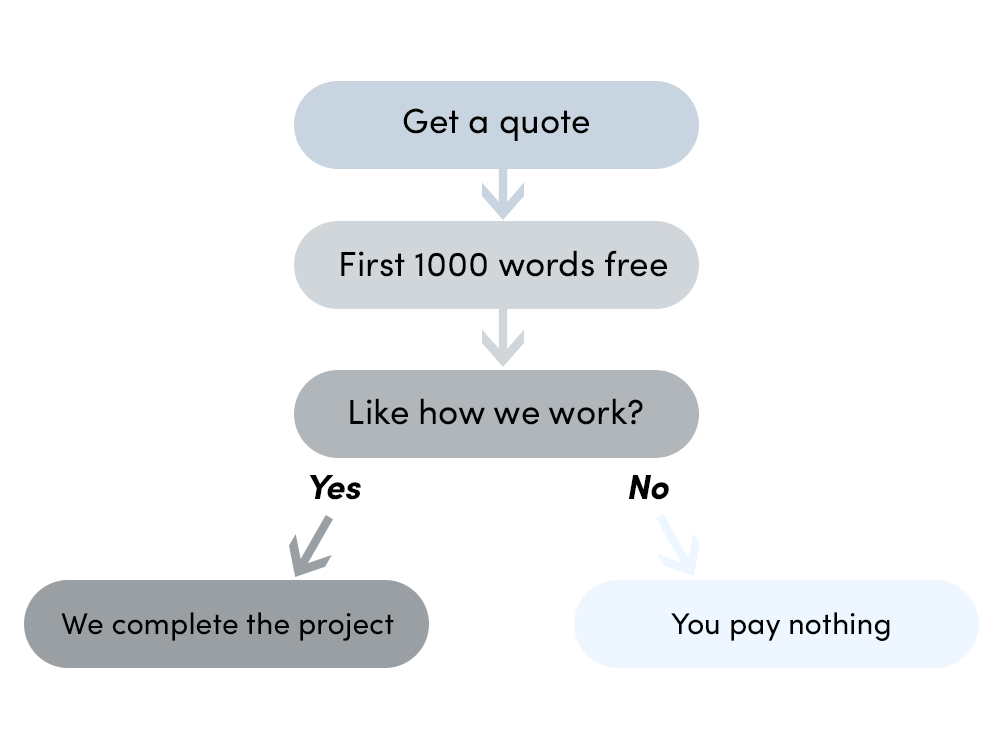
If you’re working to a fixed regulatory window and need an audit-ready plan, take a practical first step: get a quick quote and indicative timeline here — https://www.lingvohouse.com/quick-quote/