When Speed-to-Market Breaks Quality: The Hidden Cost of Translation QA
Marina Lopez had been a Product Localisation Lead for three years before she learned that procurement excellence and localisation quality rarely speak the same language.
It was 2023, and her company had just secured Series B funding. The mandate was clear: launch in Germany, Japan, and Brazil within six months. Marketing had the campaigns ready. Engineering had the builds prepped. Marina had a procurement-approved LSP that promised competitive rates and two-week turnarounds.
Launch day in Germany arrived on schedule. By day three, customer support was flooded. A consent toggle was mislabelled, making GDPR compliance ambiguous. Currency formatting broke in the checkout flow. The help documentation used formal “Sie” where the product voice demanded informal “du” — a brand inconsistency that made the entire experience feel disjointed.
The fixes cost €47,000 in emergency revisions and delayed the Japan launch by five weeks.
The procurement decision that looked optimal in the RFP scoring matrix had missed something fundamental: translation isn’t the deliverable. Quality assurance infrastructure is.
For Procurement Month, this article examines why traditional vendor selection frameworks fail in software localisation — and what forward-thinking procurement leaders are doing differently.
The Procurement Paradox in Software Localisation
Most procurement frameworks were designed for tangible goods or well-defined services. Translation procurement inherited these frameworks, optimising for cost per word, turnaround time, and linguistic credentials.
But software localisation operates under different physics. It’s not a project with a beginning and end. It’s a continuous stream of micro-content updates deployed across agile sprints, where a single mistranslated variable can cascade into broken user flows.
The traditional procurement question — “Can you translate 50,000 words in two weeks?” — is the wrong question.
The right question is: “Can your QA infrastructure prevent us from shipping broken translations into production?”
That shift in framing changes everything about how you evaluate vendors.
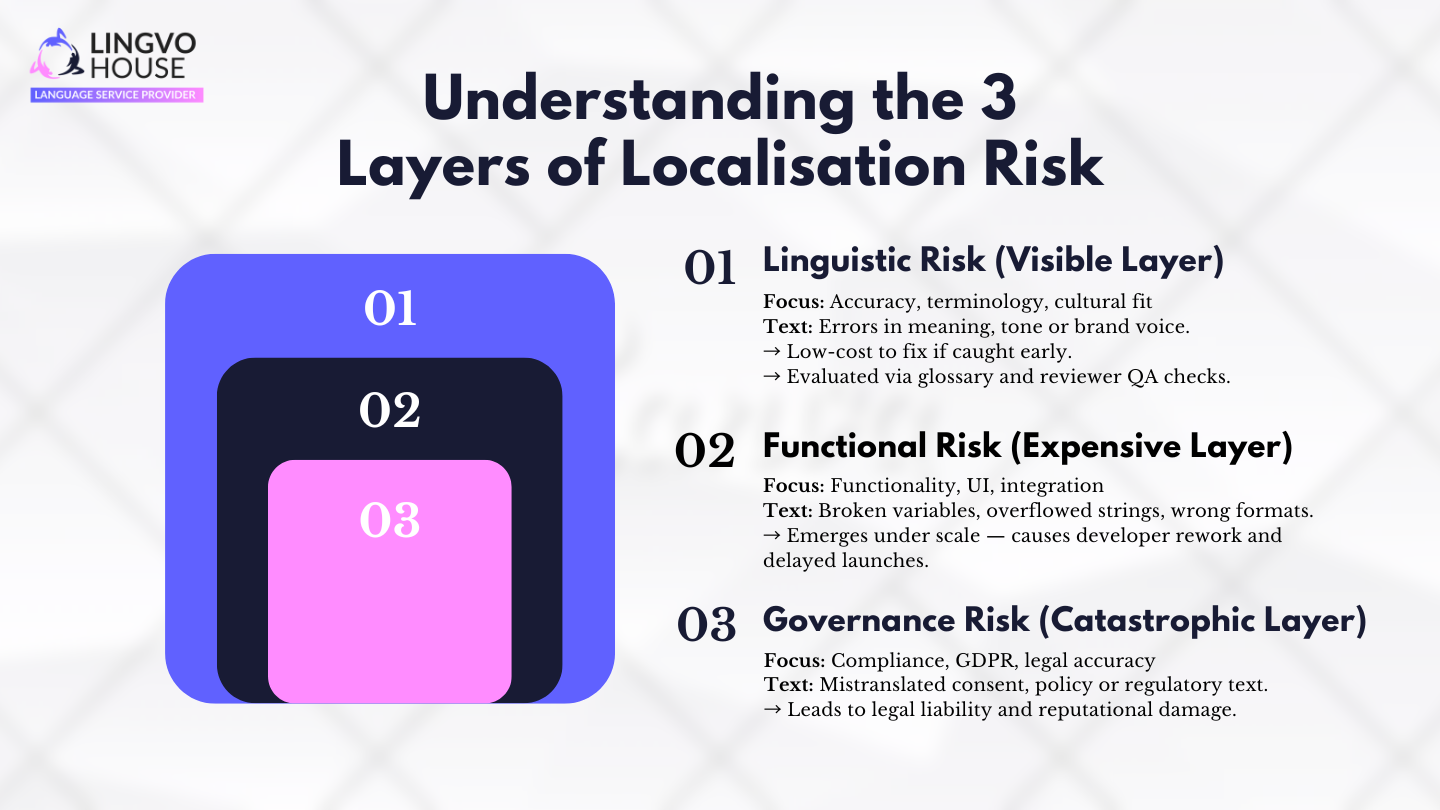
Understanding the Three Layers of Localisation Risk
Layer One: Linguistic Risk (the visible risk)
This is what everyone knows to evaluate: accuracy, terminology consistency, cultural appropriateness. It’s measurable through reviewer credentials, glossary management, and sample quality checks.
But linguistic risk is only the surface layer — and ironically, it’s the least costly to fix when caught early.
Layer Two: Functional Risk (the expensive risk)
Functional risk emerges when translations break product functionality. Examples include:
-
Variables and placeholders that get translated when they should remain code-stable
-
String length overflow in UI elements that weren’t designed for German compounds
-
Date formats that ignore locale-specific conventions
-
Right-to-left language rendering that breaks navigation logic
These issues rarely appear in sample translations during vendor evaluation. They emerge at scale, under production conditions, when QA tooling is inadequate or absent.
The cost? Emergency developer time, release delays, and customer experience degradation.
Layer Three: Governance Risk (the catastrophic risk)
This is the risk that keeps General Counsels awake. A mistranslated consent mechanism that violates GDPR. A localised product claim that creates unintended regulatory exposure. A privacy policy translation that contradicts the English source of truth.
In regulated industries or data-sensitive products, governance risk can trigger compliance investigations, legal liability, and reputational damage that far exceeds the localisation budget.
Traditional procurement rarely evaluates vendors on Layer Two and Three risk mitigation — because these risks are invisible until they materialise post-deployment.
The QA Infrastructure Gap: Why ‘Tools’ Don’t Equal Quality
When procurement RFPs ask “What CAT tools do you use?”, most LSPs list the same platforms: Trados, MemoQ, Phrase, Smartcat.
But tool ownership and tool mastery are different capabilities.
The sophisticated question is: How is your QA infrastructure architected to prevent the three layers of risk?
What best-in-class QA infrastructure looks like:
-
Automated linguistic validation Not just spell-check. Rule-based engines that flag terminology inconsistencies, untranslated segments, placeholder corruption, and style guide violations — before human review begins.
-
Functional testing integration QA processes that include pseudo-localisation testing (to catch UI breaking before translation starts) and in-context linguistic review (to validate translations within the actual product UI, not just in spreadsheets).
-
Continuous localisation compatibility API-first workflows that integrate with your version control systems, enabling daily or sprint-based translation updates without breaking QA consistency. This matters for SaaS products deploying features weekly.
-
Compliance traceability ISO 17100-certified workflows that document every translation decision, reviewer action, and quality checkpoint — creating an audit trail for governance and regulatory purposes.
-
Human-in-the-loop AI governance Structured frameworks for when machine translation is acceptable (low-risk internal documentation), when it requires post-editing (high-volume help content), and when it’s prohibited (legal disclaimers, consent flows). Without this governance layer, AI introduces unquantified risk.
The LSPs who have built this infrastructure don’t just translate faster or cheaper. They prevent your organisation from shipping risk into production markets.
Price vs Quality: The Real Cost of Cheap Translation Procurement
Here’s what procurement-driven price optimisation typically looks like in localisation:
-
Select the lowest-cost vendor who meets minimum linguistic qualifications
-
Negotiate volume discounts based on word count
-
Measure success by on-time delivery and budget adherence
Six months later, here’s what the P&L actually shows:
-
23% of initial translations required post-launch revisions
-
Developer time diverted from product roadmap to fix localisation-induced bugs
-
Market launch in France delayed by eight weeks due to UI formatting issues
-
Customer satisfaction scores in Germany 14 points below English-language baseline
The “savings” evaporated. But because these costs were distributed across Engineering, Support, and Marketing budgets, procurement never saw the full picture.
The hidden cost of inadequate QA infrastructure is the organisational tax on every department that touches localisation.
Forward-thinking procurement teams are starting to measure vendor performance differently. Not on cost-per-word, but on total cost of quality — including rework rates, time-to-fix, and cross-functional impact.
A Smarter Framework: Five Procurement Questions That Reveal QA Maturity
If you’re running a tender for software localisation services — especially for continuous deployment SaaS products — here are five questions that separate vendors with real QA infrastructure from those simply reselling commodity translation:
1. “Show me your QA error taxonomy and how you measure linguistic error rates.”
What you’re testing: Whether they have structured, measurable quality processes or subjective review workflows.
Red flag response: Vague references to “native-speaker review” without error classification systems.
Strong response: A documented error taxonomy (critical/major/minor), historical error rate data, and corrective action processes when thresholds are breached.
2. “How do you handle continuous localisation for products that deploy updates daily?”
What you’re testing: Whether they can operate in agile environments or only in waterfall-style project batches.
Red flag response: “We can turn around translations in 48 hours” (missing the point that continuous localisation requires integration, not just speed).
Strong response: API-first platforms, Git integration capabilities, and established workflows for managing incremental string updates without version conflicts.
3. “Walk me through how you would QA a translation that includes dynamic variables, formatted currency, and user-generated content interpolation.”
What you’re testing: Understanding of functional risk and technical translation complexity.
Red flag response: Focus only on linguistic accuracy without mentioning placeholder preservation or locale-specific formatting validation.
Strong response: Discussion of pseudo-localisation testing, variable validation rules, and in-context QA processes within staging environments.
4. “What happens when a translation passes linguistic QA but breaks the UI in production?”
What you’re testing: Accountability and incident response maturity.
Red flag response: “That would be a development issue, not a translation issue.”
Strong response: Clear escalation protocols, remediation SLAs, and discussion of how functional QA is incorporated into their workflow to prevent this scenario.
5. “How do you ensure compliance traceability for regulated content like consent flows and privacy policies?”
What you’re testing: Whether they understand governance risk and have audit-ready processes.
Red flag response: “Our translators are certified.”
Strong response: ISO 17100 certification details, revision history tracking, legal translation protocols, and documented review chains for regulatory content.
The answers to these five questions will tell you more about QA capability than any pricing spreadsheet or linguist CV.
Procurement 2025: The Shift from Cost Efficiency to Quality Governance
We’re at an inflection point in localisation procurement. Three forces are converging:
-
AI translation has commoditised speed. Every LSP now has access to neural machine translation. Speed is no longer a differentiator. Quality governance is.
-
Continuous deployment has made QA infrastructure critical. As release cycles accelerate, the cost of shipping broken translations escalates. The procurement advantage has shifted from “fast and cheap” to “integrated and reliable.”
-
Compliance scrutiny has intensified. GDPR, accessibility mandates, and AI transparency regulations mean that translation quality is increasingly a governance issue, not just a marketing concern. Procurement now owns reputational risk.
For Procurement Month 2025, the strategic question for SaaS organisations should be:
Are we procurement professionals selecting vendors — or are we risk managers securing linguistic infrastructure?
Because if your evaluation criteria still prioritise cost-per-word over QA infrastructure maturity, you’re optimising for the wrong outcome.
From Translation Vendor to Infrastructure Partner: A Case Study in QA ROI
Let’s return to Marina Lopez, the Product Localisation Lead from our opening story.
After the Germany launch crisis, she restructured the vendor evaluation process. The next RFP included QA infrastructure requirements: automated validation rules, functional testing protocols, API integration capabilities, and ISO 17100 certification as table stakes.
The winning vendor wasn’t the cheapest. Their per-word rate was 18% higher than the incumbent.
But twelve months later, the metrics told a different story:
-
Post-launch revision rate dropped from 23% to 4%
-
Time-to-market for new language launches improved by 40%
-
Developer time spent on localisation-induced bugs decreased by 67%
-
Customer satisfaction scores in international markets matched English-language baseline
The total cost of quality — when measured across the entire organisation — was 31% lower than the previous “cost-optimised” vendor.
Marina’s procurement partner, who initially resisted the higher per-word rate, became an advocate. They had discovered what mature localisation procurement looks like: vendor selection based on infrastructure capability, not just linguistic output.
Choosing With Confidence: Building QA-Centric Localisation Procurement
For procurement leaders evaluating LSPs this Procurement Month, the message is clear: software localisation is not a translation procurement challenge. It’s a quality infrastructure procurement challenge.
The vendors who understand this don’t just deliver words in different languages. They deliver integrated QA systems that prevent your organisation from shipping risk into global markets.
They bring:
-
Automated validation engines that catch errors before human review
-
Continuous localisation workflows that match your deployment velocity
-
Compliance-grade audit trails that protect against regulatory exposure
-
Hybrid AI governance that balances efficiency with quality assurance
And most importantly, they understand that in global SaaS, speed is expected, but quality is what builds market trust.
If your current localisation vendor can’t articulate their QA infrastructure in detail — or if your procurement evaluation framework doesn’t explicitly measure QA maturity — you’re not buying localisation services. You’re buying future risk.
LingvoHouse has been building ISO 17100-certified QA infrastructure for software localisation since 2008. If you’d like to benchmark your current vendor’s QA capabilities or explore how structured quality governance could protect your next global launch, our advisors are available for confidential consultations during Procurement Month and beyond.
Because in our experience, the most expensive translation is the one you have to fix after deployment.