Situation
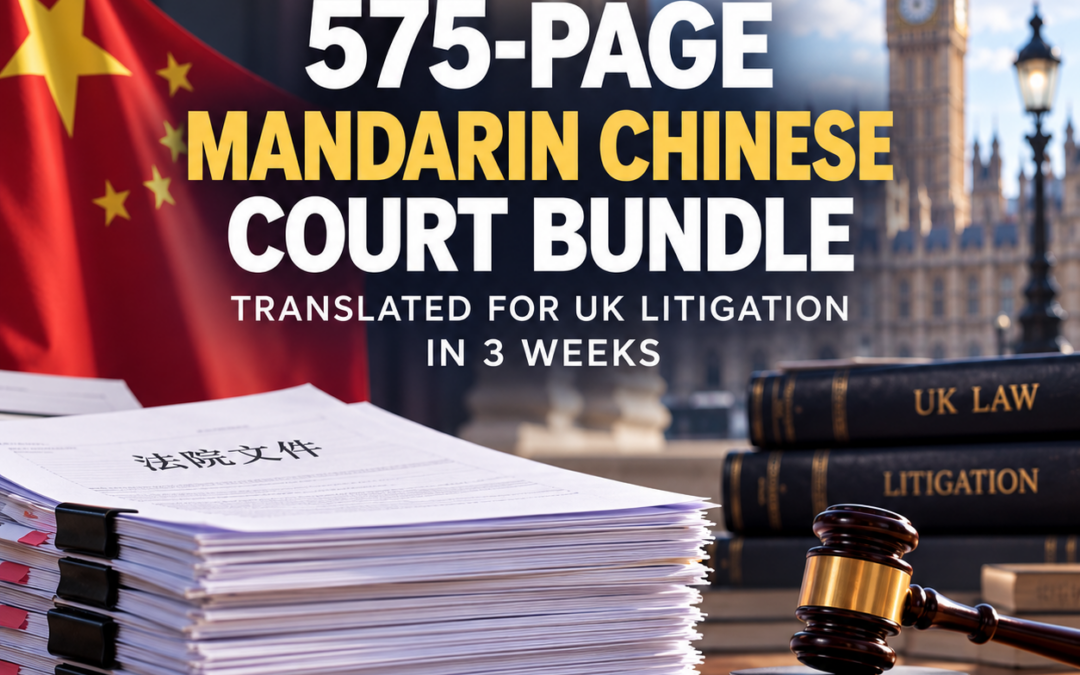
The instruction arrives on a Monday. Court date is confirmed. The bundle runs to 575 pages: a mixture of typed legal documents in Mandarin Chinese, scanned invoices, financial correspondence, and handwritten receipts — some barely legible, some photographed at an angle. Your translation supplier has not seen any of it yet. You have three weeks.
This is not a hypothetical. It is the precise situation a solicitor at a major international law firm with a global disputes and litigation practice faced earlier this year. The documents needed to be in English. The court date was fixed. The volume was not going to shrink. The question was not whether to get the translation done, but how to structure the instruction so that it did not become a crisis.
Large court bundle translation in UK litigation is a process problem as much as a language problem. The firms that handle it most effectively are not the ones with the most bilingual contacts. They are the ones that have worked out how to treat a large document set as a managed workflow rather than a single job.
Why Volume Is Not the Only Variable
The 575-page figure is significant, but it is not the hardest part of a job like this. The harder variable is document heterogeneity.
A bundle that contains 575 pages of typed Mandarin Chinese legal text is a different proposition from a bundle that contains 200 pages of typed text, 150 pages of scanned financial records, 80 pages of correspondence, and 145 pages of handwritten receipts in varying states of legibility — even if the total page count is similar.
Scanned documents that cannot be edited require a different handling process. Handwritten or partially legible material requires a judgment call at the translator level: where text is unclear, that uncertainty needs to be flagged explicitly rather than silently resolved. Financial records — invoices, payment confirmations, bank correspondence — carry a precision requirement that general-purpose translation workflows are not always set up to meet. Dates, account references, transaction amounts, and currency conversions all need to pass through a quality-control stage that is specific to numerical accuracy.
In Chinese-to-English commercial litigation work, the document mix often includes material that originated across multiple contexts: internal corporate communications drafted in formal register, supplier invoices in informal or abbreviated language, and regulatory correspondence using official terminology. Each register carries different translation risk. A translator working at speed through a mixed bundle without explicit workflow guidance around document type will, under pressure, default to a single approach — and that is where inconsistency enters.
When a solicitor instructs a large court bundle translation for UK litigation, the instruction that matters most is not the headline page count. It is the document breakdown.
What Most Suppliers Get Wrong With Large Volume Instructions
The most common failure mode in large court bundle translation is treating the instruction as a single event rather than a workflow.
A supplier who receives 575 pages on Monday and commits to delivery on a fixed date is making a bet. If the documents were provided all at once, in editable format, with consistent terminology, from a single author, that bet is manageable. In practice, court bundle instructions rarely look like this. Documents are often provided incrementally as the instructing solicitor consolidates the file. Some pages arrive later than others. New documents are sometimes added after the initial instruction — because the bundle itself is still being assembled.
A supplier who is set up to receive a single batch has no process for handling rolling additions. The workflow starts, the translation team is allocated, and mid-way through, a new tranche of documents arrives. If the supplier has no mechanism for integrating late additions without restarting the quality-control cycle, the result is either a delay or an inconsistency: terminology decisions made in week one are not automatically applied to documents that arrive in week two.
The second common failure is in the handling of mixed document types. A supplier without structured quality-control stages for financial documents specifically — invoices, receipts, account statements — will apply the same review process to a witness statement and a scanned payment confirmation. The linguistic quality check that works for narrative legal text does not catch a transposed figure in a financial record.
The third failure is communication. Solicitors managing a live litigation matter cannot afford to discover, days before a court hearing, that a portion of the bundle was not translatable in the time available, or that a document the translator could not read clearly was resolved without flagging. Suppliers who do not build in systematic progress reporting create information asymmetry at exactly the moment the client most needs certainty.
What a Well-Structured Large Bundle Workflow Looks Like
The Mandarin Chinese court bundle instruction handled by LingvoHouse earlier this year illustrates what a structured approach to large court bundle translation in UK litigation looks like in practice.
The instruction was broken into tranches from the outset, with rolling delivery agreed at the point of instruction rather than at the point of crisis. Documents were provided in batches as the instructing solicitor consolidated the file. Translated pages were returned in the same batches — reviewed, formatted, and usable — so that the legal team could begin working with translated material within days of instruction rather than waiting until the entire bundle was complete. By the time the final tranche arrived, the majority of the document set was already in English and had been through quality control.
Document types were separated at the intake stage. The typed legal documents — contracts, corporate communications, court filings — went through an ISO 17100-certified translation workflow: professional translator, independent review, and a final quality check before delivery. The scanned financial documents were handled under the same workflow but with an additional stage focused specifically on numerical accuracy: figures, dates, references, and amounts were verified against the source material before the document was signed off. Where text in a scanned document was partially illegible, the uncertainty was flagged explicitly in the translation — not resolved silently.
The file handling throughout was managed under ISO 27001 certification. In commercial litigation involving financial records and corporate correspondence, document security is not optional. The chain of custody for translated documents needs to be as clean as the chain of custody for the originals.
For solicitors working within an ISO 17100-certified translation workflow, the output is a translated document that has passed through documented stages of quality control — which means it can be evidenced as such if questioned. In litigation, that matters.
LingvoHouse holds ITI Corporate Member status and operates under ISO 9001 quality management alongside ISO 17100 and ISO 27001 certification. For large court bundle translation work, the combination of quality management and information security certification is not a checklist item — it is the structural basis for being able to make commitments on volume, timeline, and accuracy simultaneously.
What to Ask Before You Instruct a Large Bundle Translation
If you are a solicitor or legal operations manager instructing a large court bundle translation for UK litigation, the questions worth asking before the work begins are more specific than “can you turn this around in three weeks.”
Ask how the supplier handles rolling delivery. A supplier who can only receive documents in a single batch will struggle if your bundle is still being assembled when the instruction goes out. Confirm that the supplier has a process for integrating additional documents mid-workflow without restarting the quality-control cycle — and that translated batches can be returned incrementally.
Ask how mixed document types are handled. Legal narrative text, financial records, scanned documents, and handwritten correspondence each carry different accuracy requirements. Ask whether the supplier applies differentiated quality-control processes to different document types, or whether everything goes through the same review stage.
Ask what happens when a document is partially illegible. In litigation, ambiguity in the translation needs to be surfaced, not resolved invisibly. A supplier whose workflow includes explicit flagging of uncertain text is giving you information you can use. A supplier who resolves unclear text without flagging is creating a risk you will not know about until it matters.
Ask for certification. ISO 17100 is the international standard for translation services management — it specifies requirements for the translation process, the people involved, and the quality-control stages. ISO 27001 is the standard for information security management. For court bundle translation involving confidential commercial documents, both are relevant. Ask whether the supplier holds both, and whether the specific workflow being applied to your bundle operates under those standards.
Ask about progress reporting. For a bundle with a fixed court date, you need to know the status of the translation at regular intervals — not because you do not trust the supplier, but because your ability to manage the litigation file depends on knowing which documents are in English and which are not. Confirm the reporting cadence before the instruction goes out.
Outcome
The 575-page instruction completed on time. The rolling delivery model meant the instructing solicitor had usable translated documents from the end of week one. The financial records and scanned documents were returned with explicit notation where source legibility was limited. The court date was met.
The operational lesson is not that large court bundle translation is simple if you find the right supplier. It is that the workflow conversation needs to happen at the point of instruction — not when the deadline is already in view. For solicitors managing complex litigation with multilingual document sets, the question of how the translation will be structured is as important as the question of whether it can be done.
Work with LingvoHouse on a Similar Instruction
LingvoHouse handles large court bundle translation in UK litigation, including mixed document sets, rolling delivery, and urgent turnaround against fixed hearing dates.
For a full overview of LingvoHouse’s legal translation services, see the Urgent Legal Translation Services for Law Firms in the UK page.
For court bundle translation, see the Court Bundle Translation Services page. For same-day witness statement translation, see the Same-Day Witness Statement Translation for Solicitors page.
For the CPR-compliant witness statement framework, see the CPR-Compliant Witness Statement Translation for Personal Injury and RTA Solicitors page.
For pricing — including Legal Aid rates for qualifying instructions — see the Legal Translation Pricing & Rate Guide for UK Law Firms page.