When Does “Good Enough” Translation Become a Public Trust Issue in UK Public Sector Procurement?
Michael had been a procurement manager at a regional health authority for eight years. He’d managed everything from IT infrastructure to facilities management with confidence. But when the pandemic hit and his organisation needed patient information translated into 12 languages within 72 hours, he discovered a blind spot he didn’t know existed.
The LSP they’d appointed through their framework agreement delivered on time. The invoices looked right. The files arrived in the correct formats.
Then the complaints started coming in.
A community liaison officer flagged terminology inconsistencies between the website and printed materials. A GP surgery reported that patients were confused by the treatment instructions. And most damaging of all: a local councillor raised concerns in a public meeting about whether the translations were actually helping or hindering vaccine uptake in minority communities.
The problem wasn’t that Michael had chosen a bad supplier. He’d done everything right according to the traditional procurement playbook. The problem was that the playbook was written for buying staplers and software licences — not for purchasing something as nuanced, high-stakes, and culturally sensitive as human communication across language barriers.
This is the invisible crisis in public sector translation procurement. And if you’re reading this during National Procurement Month, it’s time we talked about it honestly.
Why Is Translation Procurement in the UK Public Sector Different from Other Professional Services?
Here’s what makes translation procurement fundamentally different — and why so many otherwise excellent procurement professionals find themselves in Sarah’s position:
What Is the Hidden Translation Quality Problem in UK Public Sector Procurement?
When you buy a fleet of vehicles, you can inspect them. When you hire a consultancy, you can review their methodology. But translation quality? That’s invisible until someone who speaks both languages — and understands the subject matter — reviews the work.
By then, you’ve already paid. The materials are already distributed. The damage to trust is already done.
This “quality time-lag” means traditional procurement evaluation methods — lowest price, fastest delivery, most certifications listed—often select for exactly the wrong outcomes.
What Is the Compliance Paradox in UK Public Sector Translation Tenders?
Public procurement rightly demands transparency, competition, and value for money. But here’s the paradox: the more you commoditise translation in your tender specifications (price per word, turnaround in hours, word count requirements), the more you incentivise suppliers to optimise for those metrics instead of what actually matters — accurate, culturally appropriate communication that serves your diverse communities.
The most compliant bid isn’t always the most competent one.
How Should UK Public Sector Buyers Balance AI vs. Human Translation Without Falling Into the Technology Trap?
Machine translation has evolved dramatically. Neural MT can now produce remarkably fluent text. And yes, it can reduce costs significantly.
But here’s what the sales pitches don’t tell you: MT is brilliant at translating words and terrible at translating meaning. It doesn’t understand that “vulnerable adults” and “fragile adults” have different policy implications. It can’t grasp that a phrase appropriate for London might be offensive in Leeds, or that medical instructions require precision that marketing copy doesn’t.
The question isn’t “Should we use AI?” The question is: “Do we have an LSP sophisticated enough to know when human expertise is non-negotiable, and confident enough to tell us no when we’re making a cost decision that will become a reputational risk?”
What Do Translation Procurement Best Practices Look Like for UK Public Sector Buyers?
After interviewing dozens of procurement leaders across central government, local authorities, NHS trusts, and educational institutions, a pattern emerges. The organisations that consistently get translation right share five characteristics:
1) How Do Leading UK Public Bodies Buy for Outcomes, Not Outputs, in Translation Procurement?
Poor procurement asks: “How much does it cost to translate 10,000 words?”
Excellent procurement asks: “What does success look like for this multilingual communication, and how do we build accountability for that outcome into our supplier relationships?”
One council leader put it brilliantly: “We stopped buying translations and started buying communication equity. Same budget, completely different supplier conversations.”
2) How Do You Model Total Cost of Quality for UK Public Sector Translation Projects?
Translation projects fail in predictable ways:
- Inconsistent terminology across departments creates public confusion
- Lack of review cycles means errors aren’t caught until after publication
- No translation memory means you’re paying to re-translate the same content repeatedly
- Poor project management creates bottlenecks that delay critical communications
Organisations that excel at translation procurement create Total Cost of Quality models that capture these hidden costs upfront, rather than discovering them project-by-project.
A senior procurement officer at a large NHS trust shared this insight: “When we modelled the cost of one mistranslated patient leaflet — including staff time to field confused calls, reprinting, and the reputational risk — it was 40 times the original translation cost. That changed how we evaluated bids.”
3) How Should UK Tender Managers Pre-Qualify Translation Agencies (LSPs) for Capability, Not Just Compliance?
ISO certifications matter. Framework membership matters. Insurance and financial standing matter.
But they’re table stakes, not differentiators.
The best procurement teams use mini-competitions and pilot projects to test what really predicts success:
Can the supplier handle linguistic complexity? (Try a technical document with specialised terminology)
Do they maintain consistency at scale? (Send them content from different departments and see if terminology aligns)
How do they handle ambiguity? (Give them a culturally sensitive piece and assess whether they ask intelligent questions or just translate literally)
What happens when deadlines compress? (Test their surge capacity with a realistic pressure scenario)
One procurement manager described this as “dating before marriage.” It costs a little more upfront, but prevents expensive divorces later.
4) How Do You Build a Strategic Partnership with a UK Translation Agency (LSP) Rather Than a Transactional Vendor?
Here’s a revealing question: When was the last time your translation supplier proactively told you that you were wasting money?
Excellent LSPs do this routinely. They’ll say: “This content is 60% identical to something you had translated last year — we can leverage your translation memory and cut costs by 40%.” Or: “This document doesn’t need the premium quality tier; standard human review will be sufficient.”
But suppliers only make those suggestions when they trust the relationship will continue and when they believe you value honesty over sales optimisation.
The procurement teams that build these relationships share three practices:
- They consolidate translation spend with fewer, more capable suppliers rather than fragmenting it
- They share forecasts and strategic plans so suppliers can plan capacity
- They involve LSPs early in campaign planning, not just at the execution stage
As one director of procurement put it: “We stopped thinking of our LSP as a vendor and started thinking of them as an operational partner who happens to sit outside our organisation chart.”
5) How Can UK Procurement Teams Future-Proof Translation with AI, LLMs, and Technology-Enabled Workflows?
The translation industry is in the midst of a technological revolution. Large Language Models, real-time translation APIs, AI-assisted post-editing, and neural MT are evolving rapidly.
But technology disruption cuts both ways. It can reduce costs dramatically — or it can create spectacular failures when applied inappropriately.
Forward-thinking procurement leaders ask LSPs:
“How are you using AI to improve speed and consistency for low-risk content?”
“When do you override the AI recommendation and insist on human translation?”
“How do you ensure AI-assisted translation still maintains our terminology and tone of voice?”
“What’s your data governance model when content passes through AI systems?”
The organisations getting this right aren’t choosing between human and AI translation. They’re selecting partners sophisticated enough to orchestrate both — using the right tool for the right content at the right moment.
How Do You Spot Quality Under CCS RM6141 and Other UK Public Sector Translation Framework Agreements?
Let’s address the elephant in the room: when you’re procuring through Crown Commercial Service RM6141 or another framework agreement, you might face dozens of qualified suppliers all meeting the baseline requirements.
How do you differentiate when everyone has ISO certifications and everyone claims excellence?
What Evidence Shows Operational Maturity in a UK Translation Agency?
Translation Memory ROI: Ask suppliers to quantify cost savings from translation memory reuse across previous framework contracts. Vague answers suggest immature processes.
Quality Metrics: Request actual quality audit data — error rates, revision cycles, customer satisfaction scores. “We deliver excellent quality” means nothing without evidence.
Technology Integration: Can they connect to your content management systems, procurement platforms, or accessibility tools via API? Or will every project require manual file transfer?
Specialist Networks: Do they maintain in-house expertise for your sectors (healthcare, education, legal, social services) or do they broker everything to freelancers?
How Do You Test Commercial Flexibility in Translation Framework Call-Offs?
Frameworks provide structure, but your needs are dynamic. The best LSPs balance compliance with adaptability:
- Can they handle urgent turnarounds without exploiting premium pricing?
- Do they offer volume-based efficiency gains, or is every project priced atomically?
- Will they pilot new approaches (like AI-assisted workflows) and share savings?
- How do they handle scope changes mid-project?
One procurement lead shared this litmus test: “I ask suppliers to walk me through their most challenging framework project — what went wrong, and how they recovered. Their answer tells me everything about how they’ll handle the inevitable crisis on my project.”
How Do You Assess Cultural and Sector Expertise for NHS, Local Government, and Education Translations in the UK?
This is where generalists fail and specialists excel.
An LSP translating NHS patient information should understand clinical terminology, health literacy principles, and the cultural nuances of discussing health in different communities.
An LSP working for local government should grasp policy language, accessibility requirements, and the sensitivity needed for safeguarding or housing materials.
Ask: “What’s your process for ensuring cultural appropriateness, not just linguistic accuracy?”
If the answer focuses purely on native-speaker translators, that’s necessary but insufficient. Look for evidence of community review, cultural consultation, and testing with target audiences.
What Is the Real-World ROI of Getting UK Public Sector Translation Procurement Right?
Let’s talk about money — because that’s ultimately what procurement is judged on.
A mid-sized local authority recently shared their numbers after restructuring translation procurement:
Before: Fragmented supplier relationships, project-by-project procurement, minimal translation memory, reactive workflows
After: Strategic partnership with two specialised LSPs, integrated technology, proactive planning
Results over 18 months:
- 34% reduction in cost-per-word through translation memory leverage
- 52% reduction in revision cycles due to improved quality upfront
- 28% faster time-to-publication for multilingual content
- Zero public complaints about translation quality (down from 14 in the previous period)
But the less quantifiable benefit was the most important: Procurement stopped being a bottleneck and started being an enabler.
When communications teams needed rapid translation for public health announcements, they didn’t groan about procurement timelines. When education services planned multilingual campaigns, they involved procurement early, not as a last-minute approval step.
Translation procurement became invisible in the best possible way — so reliable and efficient that people stopped thinking about it.
What Is a 4-Week Action Plan for UK Public Sector Translation Procurement?
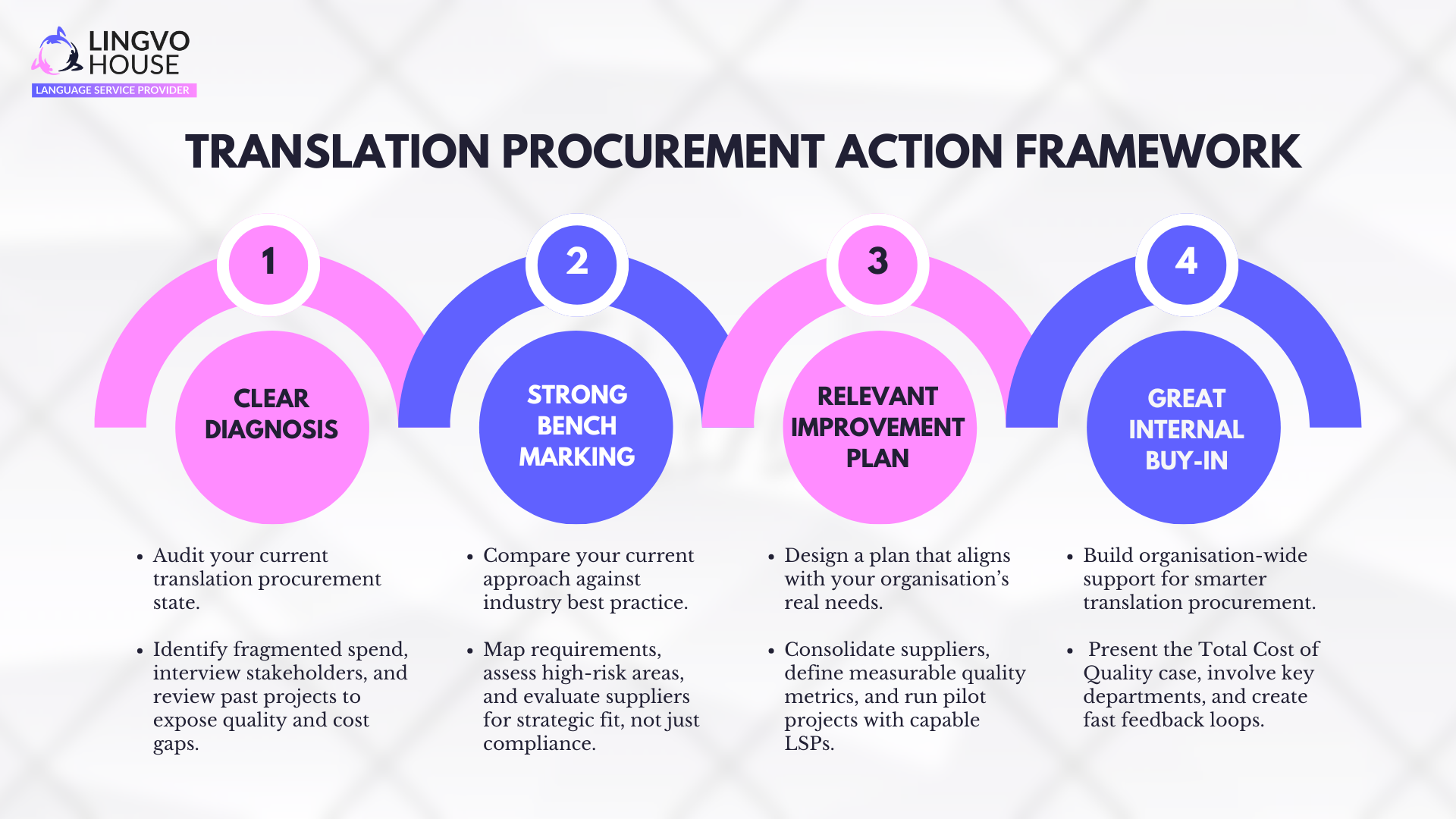
National Procurement Month is the perfect time to audit your translation procurement approach. Here’s a practical action plan:
Week 1: How Do You Diagnose Your Current UK Translation Procurement State?
Audit translation spend across all departments. You might be shocked by how fragmented it is.
Interview internal stakeholders who commission translations. What frustrates them? What’s working? Where have quality issues emerged?
Review your last three translation projects end-to-end. How many revision cycles? How many missed deadlines? What were the true costs including staff time?
Week 2: How Do You Benchmark Against UK Translation Procurement Best Practices?
Map your requirements against the framework outlined in this article. Where are the gaps?
Identify your highest-risk translation needs. What content, if mistranslated, would cause the most damage?
Assess your current suppliers honestly. Are they strategic partners or transactional vendors?
Week 3: How Do You Design a Translation Procurement Improvement Plan (UK)?
Consolidate where appropriate. Can you reduce supplier fragmentation without creating single-point-of-failure risk?
Define quality metrics that go beyond “delivered on time.” What does excellent translation actually look like?
Plan a pilot project with a more sophisticated LSP if your current arrangements aren’t delivering.
Week 4: How Do You Build Internal Buy-In for Better Translation Procurement?
Present the business case using Total Cost of Quality, not just unit price.
Involve communications, legal, and service delivery teams in supplier evaluation.
Create feedback loops so quality issues surface quickly rather than festering.
What Single Question Should UK Public Sector Buyers Ask Their Translation Agency (LSP) Right Now?
Here’s the single most revealing question you can ask in your next supplier conversation:
“What’s the most common mistake organisations make when procuring translation — and how do you help them avoid it?”
A mediocre supplier will deflect or give a generic answer.
An excellent supplier will tell you uncomfortable truths about your own procurement process — because they’ve seen the pattern enough times to know where it breaks.
The best translation partners are educators as much as executors. They raise your procurement maturity because they understand that their success is ultimately dependent on your sophistication as a buyer.
Why Does Translation Quality Matter for Public Trust in the UK?
Public sector organisations exist to serve all of their communities, regardless of language. When someone receives a translated document from their council, their health trust, or their child’s school, that document carries the full weight of institutional authority.
If it’s wrong — if it’s confusing, culturally inappropriate, or just poorly written — it doesn’t just reflect badly on the translation. It erodes trust in the institution itself.
That’s why translation procurement isn’t just about buying a service. It’s about maintaining the promise that government works for everyone, not just those who speak English fluently.
The organisations that understand this don’t treat translation as a commodity to be procured at the lowest price. They treat it as critical infrastructure for inclusive public service.
And they build procurement strategies accordingly.
Where Should UK Public Sector Buyers Go From Here for Translation Procurement Support with a UK LSP Like LingvoHouse?
If you’re a procurement professional grappling with translation quality, consistency, or value for money, you’re not alone. The challenges are real, but they’re solvable.
LingvoHouse works with public sector organisations to build translation procurement strategies that balance compliance, quality, and efficiency. Our approach combines ISO-certified workflows, intelligent technology integration, and the cultural expertise that large-scale generalists can’t provide.
We’d welcome a conversation about your specific challenges — no sales pitch, just an honest discussion about what works and what doesn’t in translation procurement.
Because when procurement gets it right, everyone benefits: departments get reliable service, communities get clear communication, and trust remains intact.
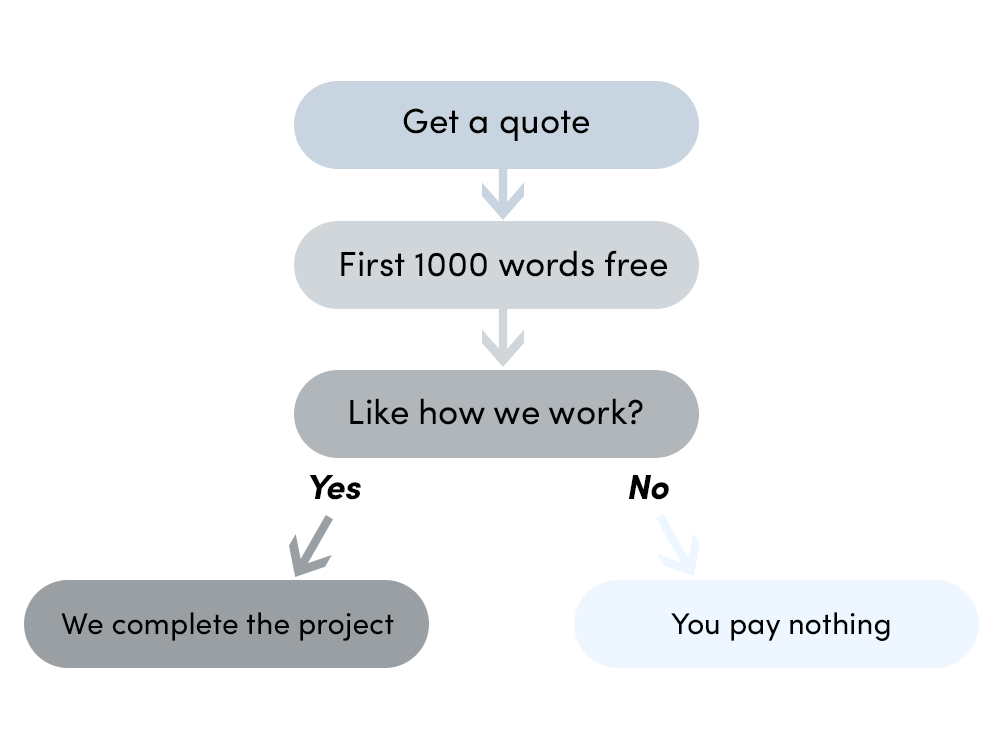
Get an instant quote or schedule a confidential consultation to explore how strategic translation procurement can reduce risk and improve outcomes for your organisation.
After all, confidence in public service starts with clarity in public communication — in every language your communities speak.